
Trade Guide
The Future of Freight: AI, IoT & Blockchain in International Shipping
The future of freight is becoming more predictive, connected, and digital. This blog explains how AI improves decision-making, IoT expands r...
Importing from Thailand into India? This practical customs guide explains HS classification, preferential duty claims, documentation, and clearance workflows. Learn how to avoid delays, reduce demurrage risk, and ensure smooth entry of Thai-origin goods into India.
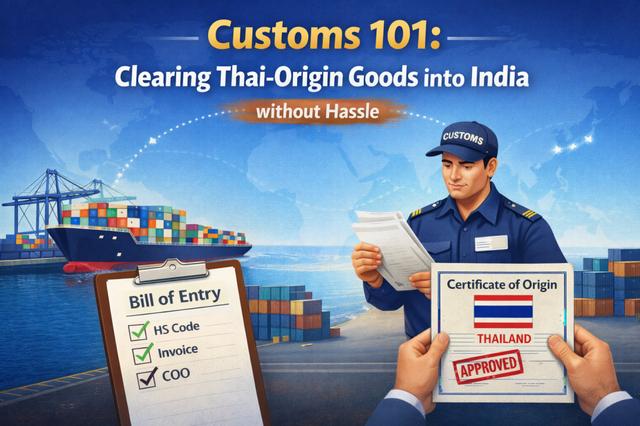
If you’ve ever had a shipment arrive on time but still lose days (and money) in customs, you already know the truth: clearance is won or lost before the vessel even sails.
For Thai-origin goods entering India, the “no-hassle” playbook is simple:
Classify correctly (HS code + policy checks)
Prepare a clean, consistent document set
Get origin + direct consignment right (especially if claiming preferential duty)
Digitize early (so your Bill of Entry doesn’t get stuck in document queries)
Here’s a practical, step-by-step guide to make Thailand → India import clearance predictable.
Before you talk rates or ETAs, lock these in:
The IOR is the party responsible for:
Filing the Bill of Entry (usually via a customs broker/CHA)
Declaring classification, value, origin
Paying duties/taxes and meeting compliance requirements
If your buyer in India is the IOR, align on who provides which documents and who bears clearance risk.
FOB/CFR/CIF: buyer typically controls Indian customs (common for B2B)
DAP/DDP: seller controls more, but DDP in India can be operationally tricky if you don’t have strong local capability
Even with digitization, clearance is still execution-heavy. A good broker:
Pre-checks classification and import policy
Manages online filings and document uploads
Pre-empts “routine” queries (valuation, catalogues, technical specs)
This is where most preventable delays begin.
For each SKU (or at least each product family):
Confirm HS code at 8 digits for India imports
Confirm duty structure and any cess/surcharges
Check if your product is under restricted category or needs licenses/NOCs
Depending on your goods, you may need partner-agency clearances (examples include food, chemicals, electronics, wireless devices, plant/animal products). If this applies, build time for:
Testing or registration
Labeling rules
Product approvals or import permits
Tip: If your product has variants, lock the HS code logic once and apply consistently-changing classification shipment to shipment attracts scrutiny.
If your goods truly qualify as Thai-origin under the applicable trade arrangement, preferential duty can reduce landed cost. But if you claim preference without being “audit-ready,” you risk:
Preferential benefit being denied
Extra duty demand and penalties
Clearance delays from origin verification queries
India’s rules place responsibility on the importer claiming preferential duty to:
Declare that goods qualify as originating
Possess sufficient information on how origin criteria are met
Exercise reasonable care in what they submit
In practice: don’t treat origin paperwork as a last-minute add-on. Treat it like a compliance file.
For ASEAN–India preferential treatment, the proof of origin often comes in a structured format (commonly referred to as Form AI). Treat it like a sensitive document:
Names/addresses must match commercial documents
HS code and product description must match invoice/packing list
Origin criterion must be correctly stated
Even if goods are Thai-origin, preferential treatment usually expects the shipment to be consigned directly per the agreement’s rules. If you route via a hub port (which is common), ensure you can prove:
The goods remained under customs control in transit
No processing occurred in the transit country (beyond permitted handling)
Shipping documentation supports continuity (e.g., through transport evidence)
Rule of thumb: If you can’t document the routing cleanly, either fix the routing documentation-or don’t claim preference.
A shipment can be physically perfect and still get held for one reason: documents don’t align.
Commercial Invoice
Packing List
Bill of Lading (or Sea Waybill, where applicable)
Insurance (if relevant to valuation / Incoterms)
Product literature/catalogues/technical specs (highly useful for queries)
Proof of origin (only if claiming preferential duty)
Before you hand docs to your broker, verify:
Consignee/Importer names match across all documents
HS code is consistent (invoice + COO/proof of origin + broker declaration)
Quantity & UOM match packing list vs invoice
Gross weight / net weight make sense (no “impossible” ratios)
Currency, unit price, totals reconcile perfectly
Country of origin is stated consistently
India customs clearance is heavily digitized. If your docs aren’t upload-ready, you lose time.
Your broker will typically file electronically and submit supporting documents digitally. To avoid upload issues:
Keep scans sharp and readable
Use consistent file naming (Invoice_123, PL_123, BL_123, COO_123, etc.)
Avoid huge file sizes; compress PDFs properly
Pro tip: Ask your broker for their “document naming + size” rules and follow them every time.
Here’s how it usually plays out operationally:
Manifest/arrival data is filed
Bill of Entry is filed (with declarations, classification, valuation, origin, etc.)
Assessment happens (often digitally; may involve queries)
Duty payment
Examination (if selected) and/or facilitated clearance
Out of Charge (customs release)
Delivery + inland movement
Speed is driven by:
Whether the shipment is facilitated or selected for checks
Whether the file triggers valuation/classification/origin questions
Whether partner-agency requirements apply
How quickly you respond to queries with clean supporting documents
Your landed cost typically includes:
Customs duty components (varies by HS and policy)
Port/terminal charges and handling
Customs broker fees
Examination and scanning fees (if applicable)
Inland transport
Storage/demurrage/detention (the big “avoidable” costs)
Demurrage / detention from clearance delays
Storage from document mismatches
Rework fees from amendments and late corrections
Best practice: Treat “free time” like cash. Track it daily once the vessel arrives.
Prevent it: pre-classify + keep technical literature ready.
Prevent it: ensure invoice terms are clear; keep price lists/POs/contracts handy.
Prevent it: claim preferential duty only when your origin story is defensible end-to-end.
Prevent it: confirm routing documents before shipping, not after arrival.
Prevent it: run a compliance check per product category and build lead time for approvals.
Prevent it: maintain a standard PDF pack and reuse templates.
Before cargo pickup
HS code confirmed (8-digit India)
Import policy checked (restricted/licensed/NOC?)
Preferential duty decision made (yes/no)
Proof of origin requirements confirmed
Transshipment route reviewed for direct-consignment compliance
Labeling/marking requirements confirmed
Before vessel sails
Invoice + packing list final (no draft versions floating around)
Bill of Lading instructions approved (names, addresses, notify party)
Product catalogue/tech specs ready for quick submission
All documents converted to upload-ready PDFs
On arrival
Broker has full doc pack + routing details
Query response owner assigned (someone who can answer within hours)
Free-time countdown tracked daily
Inland delivery plan ready (don’t wait for OOC to book trucks)
Only if you can prove origin and routing cleanly. If you’re not ready, the “savings” can evaporate into delays and disputes.
Pre-classification + document consistency + being able to respond to queries immediately with supporting evidence.
Treating customs as a paperwork step after arrival-rather than a process you engineer before shipping.
The future of freight is becoming more predictive, connected, and digital. This blog explains how AI improves decision-making, IoT expands r...

Growing import businesses often lose time and money through manual freight coordination. This blog uses published SME examples to show how d...

Learn how online freight marketplaces help importers get instant container-shipping quotes, compare options quickly, and improve booking dec...