Trade Guide
The Future of Freight: AI, IoT & Blockchain in International Shipping
The future of freight is becoming more predictive, connected, and digital. This blog explains how AI improves decision-making, IoT expands r...
Compare direct shipping and transshipment to understand how route choices affect transit time, freight cost, and supply chain reliability for importers.
For importers, the route on a freight quote is not a technical detail. It decides whether you are paying for speed, paying for coverage, or accidentally paying twice—once in ocean freight and again in delay risk.
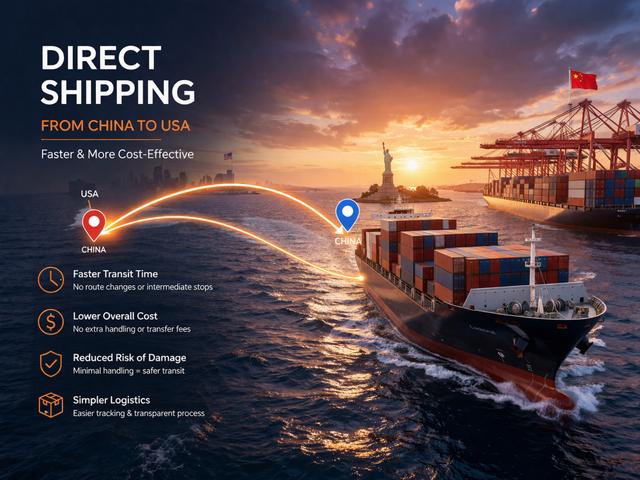
In ocean shipping, the difference is simple in principle. MSC defines a direct shipment as one where cargo is not unloaded and reloaded onto another vessel during the journey. A transshipment moves via an intermediate hub, where the container is transferred from one vessel to another. MSC also notes that direct shipments are usually quicker, while transshipment is often cheaper but comparatively longer.
Current carrier networks into India show why this matters commercially. On HMM’s 2026 Q1 FIM westbound service into west India, transit to Nhava Sheva is listed at 11 days from Shekou, 13 from Ningbo, 15 from Shanghai, and 17 from Busan. The same HMM service highlights that Southeast Asian country coverage into India is provided via Singapore transshipment. In other words, some cargo reaches India on one mainline service, while other cargo depends on a hub connection to complete the move.
That is why the right importer question is not just, “Which quote is cheaper?” It is, “What exactly am I buying in route structure, connection risk, and usable delivery date?”
Many importers compare two quotes that end at the same destination and assume the cheaper option is the better operational choice. That is too narrow a view.
India has long depended heavily on foreign transshipment hubs. In a 2023 release, the Government said nearly 75% of India’s transshipped cargo was handled at ports outside India, and that Colombo, Singapore, and Klang handled more than 85% of that cargo, with Colombo alone handling 45%. So when you choose a transshipment route, you are often also choosing one more external terminal, one more vessel window, and one more operating dependency outside your control.
That does not make transshipment a bad choice. It means it should be a deliberate one.
This is the first misunderstanding to clear up.
A direct shipment does not necessarily mean the vessel sails straight from your origin port to your destination with no intermediate calls. It means your cargo stays on the same vessel rather than being unloaded and reloaded onto another one. MSC’s definition makes that clear. HMM’s current west India FIM rotation itself includes multiple port calls before India, yet still provides defined port-to-port transit into Nhava Sheva. So the commercial difference is not “stops versus no stops.” It is same-vessel continuity versus vessel change at a hub.
For importers, that matters because same-vessel continuity usually reduces one major execution risk: the missed connection.
The second impact is on cost structure.
MSC explicitly states that transshipments are relatively cheaper than direct shipments and can reduce overall shipping costs through consolidation and economies of scale. It also notes that transshipment becomes essential where there is no direct route, or where the final port cannot accommodate a larger vessel. That is one reason hub-and-feeder routing remains common across Asia–India trades.
HMM’s own India network makes the same commercial logic visible in practice: direct mainline timings exist for major Asia–India corridors, while broader regional coverage is extended via Singapore transshipment. That means transshipment is often the way carriers make smaller-origin or secondary-port cargo commercially viable.
So if your cargo is routine, cost-sensitive, and not stockout-critical, a transshipment route may be the more efficient commercial answer.
The third impact is reliability quality.
A poor transshipment is painful. A well-controlled transshipment can be highly efficient. Maersk notes that transshipments are often seen as increasing the risk of delays and disruptions, but also says that strategic hubs can optimise routes, support competitive transit times, and improve flexibility. In a separate network note, Maersk says controlled hub design and integrated systems can reduce average dwell time in a hub terminal by up to 20%.
That is an important nuance for importers. A direct service is not automatically the better decision if it is irregular, poorly buffered, or capacity-constrained. Likewise, a transshipment route is not automatically a bad decision if the hub is productive, well-connected, and tightly controlled.
The better question is: Which hub? Which connection window? Which carrier discipline?
The fourth impact is on schedule confidence.
Sea-Intelligence reported that global liner schedule reliability was 62.4% in January 2026, and the average delay for late vessel arrivals was 5.17 days. Those are global figures, not a promise for your exact lane, but they are still a useful planning signal. When the industry is still dealing with imperfect reliability, every additional connection matters more. A direct route removes one transfer event. A transshipment route adds one more point that has to line up correctly.
At the same time, the answer is not to reject every transshipment route. MSC notes that transshipment can sometimes be faster than a direct arrival in cases where the final port is congested, because cargo can be discharged at a hub and then moved onward in a smaller vessel or different mode. That is why route choice should be made corridor by corridor, not on a blanket rule.
The fifth impact is that your route decision does not end at the vessel leg.
India’s National Time Release Study 2025 puts average seaport import release time at 79:04 hours, with wide variation by gateway: Mundra 55:34, Nhava Sheva 72:50, Chennai 88:42, and Kolkata 140:45. The same study shows advance-filed Bills of Entry at seaports moved faster, at 71:23 hours.
That means a cheaper transshipment quote is not automatically cheaper in practice, and a faster direct ocean leg is not automatically faster at warehouse level. If one route lands at a gateway that clears materially faster, or fits your inland movement better, the post-arrival path can outweigh a small ocean transit difference.
The most exposed importers are usually the ones where timing failure is commercially expensive.
That usually includes:
electronics and component importers running lean buffers
machinery and spare-parts buyers tied to project or shutdown dates
seasonal or promotional importers with fixed launch windows
pharma and chemical buyers managing production-linked inputs
businesses using air freight as a back-up when ocean timing slips
If one delayed container can force expediting, line stoppage, or lost sales, route choice is already a profit decision, not just a logistics one.
Use this before your next booking cycle:
Ask whether the quote is same-vessel/direct or via transshipment.
Ask for the hub name and planned connection point if transshipment is involved.
Compare all-in landed cost, not just ocean freight.
Separate urgent, revenue-critical SKUs from routine replenishment cargo.
Prefer direct routing for cargo where one missed connection can hurt production or margin.
Use transshipment more confidently on cost-led cargo where the hub and carrier are reliable.
Validate the Indian gateway, not just the ocean lane.
Lock documentation early so India-side clearance does not wipe out your ocean-time advantage.
Track the connection milestone, not just departure from origin.
Keep a fallback plan only for genuinely critical cargo, not every shipment.
These are the common importer mistakes in a route-choice market:
assuming direct always means non-stop
assuming transshipment is always a bad option
choosing the cheapest quote without checking the hub
treating all SKUs the same
planning around vessel ETA instead of warehouse-ready date
ignoring India-side release variation
discovering the transshipment only after booking
The pattern is simple: the label on the quote matters less than the actual operational design behind it.
This is exactly the kind of decision where visibility matters.
Cogoport’s platform is built around instant freight quotes, freight rates and schedules, end-to-end logistics services, customs support, tracking and visibility, Cogo Assured, and Pay Later. Its tracking tools are designed to give milestone visibility, ETA-delay visibility, rollover alerts, and detention-risk awareness across carriers. That matters when you are choosing between a lower-cost transshipment option and a faster or more stable direct route.
For importers, that usually means a few practical advantages:
faster comparison of direct versus transshipment options
better visibility into schedules and likely transit structure
earlier coordination of customs and inland movement
real-time tracking across shipment milestones
financing flexibility when faster routes cost more or delays stretch cash flow
When the route choice is close on price, execution visibility is often what makes the right option obvious.
Direct shipping versus transshipment is not a theoretical logistics debate. It is a working decision about what you value more on a given shipment: lower base freight, broader coverage, fewer handoffs, or tighter timing confidence.
Direct routes usually reduce one major risk point and are often the better choice for stockout-sensitive or margin-sensitive cargo. Transshipment routes often lower freight cost, expand origin coverage, and can work very well when the hub is productive and the connection is tightly managed. Current carrier networks, global reliability data, and India’s customs-release data all point to the same conclusion: you should choose the route based on SKU criticality, hub quality, gateway performance, and total landed risk, not just the cheapest quoted ocean rate.
MSC, “What is Transshipment?” Used for the definitions of direct shipment and transshipment, and for the points that transshipment is often cheaper, usually longer, can avoid congestion, and can reduce overall shipping cost through consolidation.
HMM, Service Network 2026 Q1. Used for Asia–India service structure, westbound transit-time examples into Nhava Sheva, and the note that Southeast Asian country coverage is provided via Singapore transshipment.
Maersk, “5 ways to boost ocean transshipment reliability,” 30 May 2024. Used for hub-selection logic, the risk of delay/disruption in transshipment, and the point that strategic hubs can optimise routes and support competitive transit times.
Maersk, “The Network of the Future: Service network information,” 10 Sept 2024, and Ocean Transport product page. Used for controlled-hub design, reduced dwell time, and the role of transshipment hubs in schedule reliability.
Sea-Intelligence, “2026 starts with Global Schedule Reliability of 62.4%,” 24 Feb 2026. Used for current global schedule-reliability and late-arrival data.
Central Board of Indirect Taxes and Customs, National Time Release Study 2025. Used for India’s average seaport import release time, port-wise import ART, and advance-filing timelines.
Press Information Bureau, Government of India, International Container Transhipment Port / Galathea Bay releases, 2023. Used for India’s reliance on foreign transshipment hubs and the role of Colombo, Singapore, and Klang.
Cogoport, platform and product pages. Used for current references to instant freight quotes, freight rates and schedules, tracking and visibility, customs support, Cogo Assured, and Pay Later.
The future of freight is becoming more predictive, connected, and digital. This blog explains how AI improves decision-making, IoT expands r...

Growing import businesses often lose time and money through manual freight coordination. This blog uses published SME examples to show how d...

Learn how online freight marketplaces help importers get instant container-shipping quotes, compare options quickly, and improve booking dec...