
Trade Guide
The Future of Freight: AI, IoT & Blockchain in International Shipping
The future of freight is becoming more predictive, connected, and digital. This blog explains how AI improves decision-making, IoT expands r...
Learn how to manage inventory for imports with long transit times. Balance stock levels, reduce stockouts, and optimize working capital.
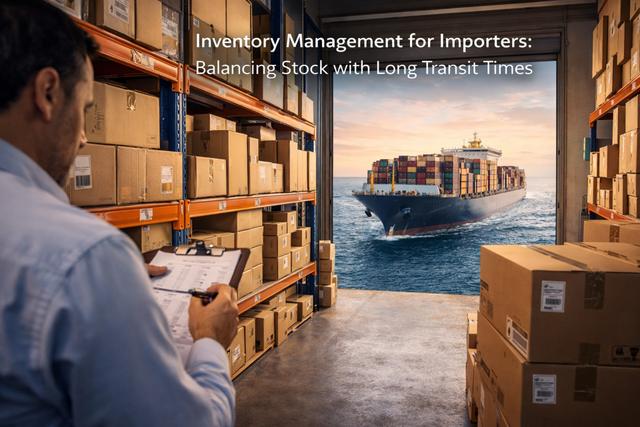
For Indian importers sourcing from Asia, inventory planning usually breaks when teams treat quoted sailing time as if it were the full replenishment cycle.
Current carrier service tables still show ocean legs that look manageable on paper. On HMM’s Asia–India services in 2026 Q1, westbound transit into Nhava Sheva ranges roughly from 11–20 days depending on the origin and service, including Shekou at 11–13 days, Ningbo at 13–16 days, Shanghai at 15–17 days, and Busan at 17–20 days. But warehouse-ready timing is longer than port-to-port timing. India’s National Time Release Study 2025 puts average seaport import release time at 79:04 hours, while Sea-Intelligence reported global schedule reliability at 62.4% in January 2026, with late vessel arrivals averaging 5.17 days behind schedule. For importers, the real question is not “How many days is transit?” but “How much stock do I need to stay available when lead time moves?”
There is one important positive signal. Government data says India’s average port dwell time is about 2.6 days, and major-port turnaround improved to 49.5 hours in FY 2024-25. That means India-side infrastructure has improved materially. But NTRS still shows big variation in actual cargo release by gateway and process, from 55:34 hours at Mundra to 140:45 hours at Kolkata in 2025. So a shipment can land broadly on time and still become usable inventory on very different dates.
A better formula for import planning is simple:
Reorder point = average daily demand × realistic availability lead time + safety stock
The important part is what sits inside “realistic availability lead time.” For importers, that should include supplier readiness, booking and cutoff discipline, ocean transit, transshipment risk, customs release, payment readiness, and inland delivery to your warehouse.
A supplier ETA is usually only a shipment milestone, not an inventory milestone.
India-side performance has improved, but release timing still depends heavily on filing discipline, customs handling, payment timing, queries, and delivery model. NTRS 2025 shows seaport imports averaged 71:23 hours when Bills of Entry were filed in advance, but 158:59 hours when filing was late. It also shows that even though single queries were raised in less than 5% of cases and multiple queries in under 1.5%, a single query pushed seaport ART close to 170 hours and multiple queries pushed it beyond 256 hours. In other words, a documentation miss or response delay can erase the benefit of a relatively stable vessel leg.
That is why inventory planning for imports is not just about carrying more stock. It is about protecting the right SKUs against the right type of delay.
The first problem is treating lead time as one fixed number.
Current HMM schedules already show that Asia-to-India timing differs materially by origin and service. On one westbound service, Shekou to Nhava Sheva is 11 days while Busan is 17; on another, Shekou is 13 and Busan is 20. On top of that, Sea-Intelligence’s January 2026 data shows global schedule reliability at 62.4%, with late vessel arrivals averaging 5.17 days behind schedule. That means the average lead time is only part of the story. The spread matters just as much.
For inventory planning, that means safety stock should be built against both demand variation and lead-time variation. If your reorder point assumes one neat transit number, you are effectively planning for the average case while your service levels depend on the late case.
The second problem is assuming documentation is a clearance issue rather than a stock-availability issue.
NTRS 2025 makes this extremely clear. At seaports, average release time for advance-filed import Bills of Entry was 71:23 hours, versus 158:59 hours for late filing. The same report shows that once customs queries are raised, timelines worsen sharply: seaport ART rises from around 79 hours overall to nearly 170 hours with a single query and over 256 hours with multiple queries.
For an importer, that means poor document readiness is not an admin delay. It is an inventory-policy mistake. If a high-rotation SKU goes out of stock because the file was late or incomplete, that is still a stock planning failure.
The third problem is planning around port arrival instead of usable inventory date.
Port choice and delivery mode change real lead time. NTRS 2025 shows port-wise seaport import ART at 55:34 hours for Mundra, 72:50 for Nhava Sheva, 88:42 for Chennai, and 140:45 for Kolkata. It also shows DPD outperforming CFS on imports across select seaports, with overall DPD ART at 65:33 hours versus 84:03 hours for CFS. Chennai’s DPD ART was 48:17 hours versus 93:51 hours for CFS, and at Nhava Sheva AEO DPD clients recorded 49:02 hours versus 81:30 hours for non-AEO DPD.
That matters for stock planning because the same container can become sellable or production-usable days earlier or later depending on the gateway and release path.
The fourth problem is assuming one shipment mode is always faster.
On the ocean side, Maersk notes that LCL is slower because it involves consolidation and more handling, while FCL is faster and benefits from fewer stops and more direct routing. But India’s customs-release data adds an important nuance. NTRS 2025 shows that at seaports, LCL import ART was 67:55 hours versus 83:54 hours for FCL in 2025. The report explains that smaller LCL consignments often attract lower duties and can therefore move through payment and release faster. Nhava Sheva, for example, showed 63:01 hours for LCL versus 77:16 for FCL.
So mode choice should be made on end-to-end inventory availability, not on a simplistic assumption that one format is always quicker. Ocean timing and customs timing may point in different directions.
The fifth problem is overcorrecting long transit by simply buying more.
Longer and more variable replenishment cycles do justify more protection on critical SKUs. But NTRS also shows how working-capital readiness affects physical availability. At seaports in 2025, the average time from assessment to payment was 102:22 hours when payment happened after assessment and no deferred payment was used. By contrast, Bills of Entry involving deferred payment at seaports had an ART of 42:47 hours. Separately, CBIC announced that Eligible Manufacturer Importers can clear imported goods without paying customs duty at the time of clearance and instead pay monthly, with the EMI facility available from 1 April 2026 to 31 March 2028.
That means extra stock is not only a warehouse decision. It is also a financing and clearance-speed decision.
Given current Asia–India transit ranges, schedule reliability slippage, and India-side release variation, the businesses that usually feel long-lead inventory stress first are the ones where a 3-to-7 day shift quickly turns into missed sales or missed production.
That usually includes:
electronics and component importers running lean stock
machinery and spare-part importers tied to service commitments
chemical and pharma input buyers feeding production schedules
seasonal importers with promotion-linked launch windows
project-driven importers who cannot afford one missing line item
businesses that use air freight as the last-resort stockout fix
If your margins or customer commitments depend on predictable availability, long transit time is already an inventory-management issue, not just a shipping issue.
Use this before your next purchase cycle:
Recalculate reorder points using warehouse-ready lead time, not sailing time.
Separate SKUs into critical, revenue-sensitive, and routine buckets.
Hold more safety stock on A-items, not blanket extra stock across everything.
Ask suppliers for realistic cargo-ready windows, not only dispatch promises.
Lock documentation before arrival wherever possible; advance filing materially reduces release time.
Choose gateway and DPD/CFS path based on availability date, not habit.
Compare FCL and LCL on full lead time, not only rate.
Make duty-payment readiness part of your inventory plan, especially on urgent receipts.
Use air freight only for shutdown-preventing or margin-protecting SKUs; DHL lists typical transit at 1–2 days for Air Priority and 5–7 days for Air Economy.
Review financing pressure early if higher stock cover is going to stretch working capital.
These are the common importer mistakes in a long-transit inventory market:
using one lead-time assumption for every supplier and every SKU
planning around vessel ETA instead of warehouse-ready date
increasing stock cover across all products instead of prioritising critical items
filing documents late and then treating the delay as bad luck
choosing gateway and delivery mode by habit
switching too much cargo to air after the stock gap has already started
ignoring the cash-flow impact of larger buffer stock
The pattern in the data is clear: delays are not created only at sea. They are also created in documentation, payment, routing, and release choices.
This is the kind of market where visibility matters as much as stock cover.
Cogoport helps importers compare freight options faster, plan bookings with better timing control, and align customs clearance, haulage, and shipment tracking in one workflow. Instead of treating freight, clearance, and inland movement as separate conversations, teams can manage replenishment with better end-to-end visibility.
That matters for a few reasons:
you can access instant freight quotes faster
you can compare mode and routing options before inventory pressure turns into a stockout
you can align customs and inland delivery earlier
you can track shipments with real-time visibility instead of fragmented updates
you can use Cogo Assured when timing confidence matters
you can use Pay Later when larger stock buffers begin affecting cash flow
For importers trying to balance service levels against working capital, better execution usually beats reactive overstocking.
Inventory management for importers is not about holding more stock everywhere.
It is about identifying where long and variable lead times actually threaten service, then protecting those SKUs with better reorder logic, earlier documentation, smarter gateway and mode choices, and selective contingency planning. Current carrier schedules, schedule-reliability data, and India customs studies all point in the same direction: the effective lead time is wider than the ocean leg alone. The importers who plan inventory against real availability dates, not nominal transit days, will usually protect both service and cash more effectively.
HMM, Service Network 2026 Q1. Used for representative Asia-to-India transit-time examples across Busan, Shanghai, Ningbo, Shekou, Nhava Sheva, Mundra, and Kattupalli.
Central Board of Indirect Taxes and Customs, National Time Release Study 2025. Used for seaport import release time, port-wise ART, advance filing, query impact, DPD vs CFS, FCL vs LCL, payment timing, and deferred-payment data.
Sea-Intelligence, 2026 starts with Global Schedule Reliability of 62.4%, 24 Feb 2026. Used for schedule reliability and average delay of late vessel arrivals.
Press Information Bureau / Ministry of Ports, Shipping and Waterways, press release on transport and port infrastructure, 31 Dec 2024. Used for India’s average port dwell time and turnaround improvement.
Press Information Bureau / Ministry of Ports, Shipping and Waterways, India’s Major Ports Achieve Historic Milestones in FY 2024-25, 13 May 2025. Used for FY2024-25 turnaround-time improvement and JNPA throughput context.
Maersk, FCL vs LCL Shipping: Deciding the Best Fit for Your Shipment, 15 Dec 2023. Used for the ocean-side comparison of FCL and LCL speed and handling.
DHL Global Forwarding India, Standard Air Freight. Used for typical air-freight transit windows.
Press Information Bureau / CBIC, CBIC introduces deferred Customs Duty payment facility, 1 Mar 2026. Used for the Eligible Manufacturer Importer deferred-duty facility.
The future of freight is becoming more predictive, connected, and digital. This blog explains how AI improves decision-making, IoT expands r...

Growing import businesses often lose time and money through manual freight coordination. This blog uses published SME examples to show how d...

Learn how online freight marketplaces help importers get instant container-shipping quotes, compare options quickly, and improve booking dec...