
Trade Guide
The Future of Freight: AI, IoT & Blockchain in International Shipping
The future of freight is becoming more predictive, connected, and digital. This blog explains how AI improves decision-making, IoT expands r...
Learn how to plan import lead times from Asia to India with realistic transit estimates, customs timelines, and freight strategies to avoid delays and cost overruns.
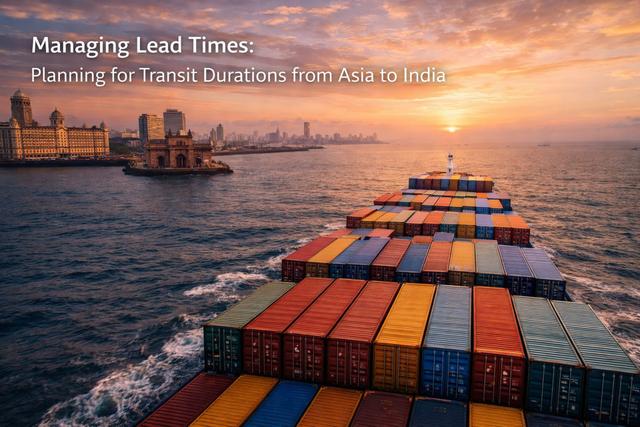
For Indian importers sourcing from Asia, lead-time planning usually breaks when teams use a sailing-time estimate as if it were the full replenishment cycle.
On representative westbound services into Nhava Sheva, official carrier transit tables still show base ocean legs that sound manageable: Shanghai around 17–18 days, Ningbo about 16 days, Shekou about 13–14 days, Busan about 16–20 days, Tianjin/Qingdao about 20–23 days, and Laem Chabang around 18 days, depending on the service rotation. But those are port-to-port numbers, not cargo-ready-to-warehouse-ready numbers. India’s National Time Release Study 2025 puts average seaport import release time at 79:04 hours, and Sea-Intelligence reported global liner schedule reliability at 62.4% in January 2026, with late vessels arriving an average 5.17 days behind schedule. For buyers importing from Asia, the useful question is not “What is the transit time?” but “What is my realistic availability date?”
A supplier may quote a lane as a two-week or three-week move, but that usually describes only the vessel leg. Many Asia–India services still route through hubs such as Singapore, Port Klang, or Colombo before or after India calls, so connection discipline and service pattern matter just as much as headline sailing time. That is why two shipments from similar origins can show very different actual arrival profiles even when the quoted lane looks similar on paper.
There is one positive trend for importers. Official government data says average dwell time at Indian ports is about 2.6 days, average turnaround time at major ports fell to 48.06 hours in FY 2023-24, and Jawaharlal Nehru Port’s turnaround time was 26 hours. That improves the operating base, but it does not remove the need for buffers because customs release, delivery mode, documentation quality, and vessel reliability still decide when cargo becomes usable.
Base Ocean Transit Depends On Origin Cluster
Carrier service tables show why origin clustering matters. South and East China origins into west India can sit in the low-to-high teens, Korea often lands in the mid-to-high teens, North China can push beyond 20 days, and Thailand services can be around the high teens. Planning one blanket “Asia to India transit time” across all suppliers is usually the first lead-time mistake.
Schedule Reliability Changes The Buffer You Need
Even when schedules look clean, reliability is not perfect. Sea-Intelligence reported global schedule reliability at 62.4% in January 2026 and said late vessel arrivals were averaging 5.17 days. That is a global benchmark, not an Asia–India lane promise, but it is still a practical planning signal: if your business breaks on a 3-to-5 day slip, your inventory policy is too tight for the market you are shipping in.
Documentation Timing Can Add Or Remove Days
India’s National Time Release Study shows advance filing is one of the clearest controllable levers. At seaports, 91% of Bills of Entry were filed in advance, and the average release time for advance-filed import cargo was 71:23 hours in 2025. For late-filed Bills of Entry, the corresponding seaport release time was 158:59 hours. In practical terms, weak documentation timing can cost importers more than three extra days after arrival.
Port And Customs Performance Still Matter After Arrival
The same NTRS data shows average seaport import release time at 79:04 hours in 2025, with meaningful port-level variation: Mundra 55:34, Nhava Sheva 72:50, Chennai 88:42, and Kolkata 140:45. The study also shows cargo moving under AEO conditions at seaports recorded 56:46 hours, much better than the seaport average. So two buyers importing similar cargo from Asia can still face very different post-arrival timelines depending on gateway choice and process control.
Mode And Shipment Design Affect The End-To-End Clock
DHL notes that direct port-to-port transit for LCL and FCL is usually similar, but LCL needs extra handling at both ends. Maersk likewise notes that as shipment size grows, shifting to FCL can improve transit times. For urgent replenishment, air freight can compress timelines sharply: DHL lists typical transit time of 1–2 days for Air Priority and 5–7 days for Air Economy. The planning takeaway is simple: choose the mode against total availability date, not only against the ocean rate.
Given the variability in sailing windows, schedule reliability, and India-side release times, the businesses that usually feel lead-time risk first are the ones where a missed ETA quickly turns into lost production or lost sales.
That usually includes:
electronics and components buyers coordinating multiple Asian suppliers
machinery and spare-part importers tied to shutdown or installation dates
chemical and pharma input buyers working around production windows
seasonal or promotional importers where late arrival destroys margin
teams that routinely use air freight to correct stock gaps
If your sourcing plan depends on lean inventory and fixed delivery promises, you should manage lead time as a range, not a single number.
Use this checklist before your next booking cycle, especially because documentation timing and gateway choice materially change India-side timing.
Split inbound POs into three buckets: production-critical, revenue-critical, and routine.
Quote by origin cluster, not by “Asia” as one region.
Ask for both port-to-port timing and realistic door-to-door timing.
Add buffer for transshipment and missed-connection risk.
Lock documentation before arrival wherever possible.
Decide FCL vs LCL on total lead time and handling needs, not only on rate.
Choose gateway based on actual post-arrival planning, not habit.
Reserve air freight for margin-protecting or shutdown-preventing cargo.
Recheck inland haulage and receiving windows before promising dates internally.
Review safety stock on SKUs where a 5-day slip hurts revenue or production most.
These are the common importer mistakes in a lead-time-sensitive market:
using one transit assumption for all Asian suppliers
planning only around sailing days
booking without cutoff discipline
choosing gateway ports by habit instead of data
treating LCL and FCL as a pure rate decision
switching to air only after the stock-out has already started
ignoring document readiness until the vessel is close to arrival
This is the kind of market where execution discipline matters more than generic averages.
Cogoport helps importers plan around real shipment movement, not just theoretical transit days. Teams can compare freight options faster, get instant freight quotes, align customs clearance and inland haulage earlier, and track shipments in one workflow instead of splitting decisions across multiple vendors.
That matters for a few reasons:
you can compare options faster before booking
you get clearer pricing visibility across modes
you can align customs and inland movement earlier
you can track shipments with better end-to-end visibility
you can react faster when a shipment starts slipping
For importers trying to protect both availability and landed cost, that mix of visibility and execution usually matters more than relying on a supplier ETA alone.
Managing lead times from Asia to India is not about memorising one transit number.
The real planning job is to combine service-dependent ocean duration, schedule reliability, documentation timing, port choice, customs release, and inland delivery into one realistic date range. Current official data makes the point clearly: carrier transit tables differ materially by origin, global schedule reliability still leaves room for slippage, and India-side release times can vary sharply depending on filing discipline and gateway. The importers who plan around ranges, buffers, and controllable process steps will usually outperform the ones who plan around a single sailing-day estimate.
Ocean Network Express, “West Asia” service maps and key transit tables. Used for representative Asia-to-India port-to-port transit examples and service rotations.
Central Board of Indirect Taxes and Customs, “National Time Release Study 2025.” Used for India seaport import average release time, port-wise ART, advance filing, and AEO comparisons.
Sea-Intelligence, “2026 starts with Global Schedule Reliability of 62.4%,” 24 Feb 2026. Used for schedule reliability and late-arrival data.
Press Information Bureau / Ministry of Ports, Shipping and Waterways, press release on maritime infrastructure and port efficiency, 31 Dec 2024. Used for average dwell time and major-port turnaround improvement.
Press Information Bureau / Ministry of Ports, Shipping and Waterways, “Average Turnaround Time of Major Ports,” 03 Dec 2024. Used for port-wise turnaround, including JNPT.
DHL Global Forwarding India, “When to Use LCL.” Used for the FCL/LCL transit-handling distinction.
Maersk, “FCL vs LCL Shipping: Deciding the Best Fit for Your Shipment,” 15 Dec 2023. Used for the point that FCL can improve transit time as shipment size grows.
DHL Global Forwarding India, “Standard Air Freight.” Used for representative air freight transit windows.
The future of freight is becoming more predictive, connected, and digital. This blog explains how AI improves decision-making, IoT expands r...

Growing import businesses often lose time and money through manual freight coordination. This blog uses published SME examples to show how d...

Learn how online freight marketplaces help importers get instant container-shipping quotes, compare options quickly, and improve booking dec...