
Trade Guide
The Future of Freight: AI, IoT & Blockchain in International Shipping
The future of freight is becoming more predictive, connected, and digital. This blog explains how AI improves decision-making, IoT expands r...
Learn how to use digital freight platforms to compare quotes, reduce shipping costs, and choose the best rates with better visibility and faster decisions.
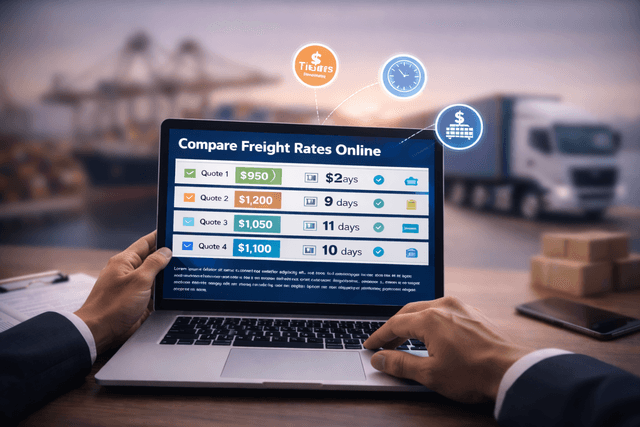
Getting a freight quote used to mean emailing a few forwarders, waiting for replies, and then trying to compare numbers that were not structured the same way. Digital freight platforms change that workflow. Freightos describes digital freight procurement as moving from “days to minutes,” while Cogoport’s own guidance says instant quotations help customers compare rates, assess service options, and make shipping decisions quickly.
But “cheaper” does not simply mean picking the lowest number on the screen. Digital comparison only saves money when the quote is valid for your shipment, the pricing structure is transparent, and the service matches your timing needs. Flexport’s quote terms say transit times are estimates, rates are valid only for the quoted validity period, dimensions, commodity, and service scope, and additional services or shipment changes can alter pricing.
The advantage of digital comparison shopping is not only speed. It is also structure. Freightos says users can compare air, ocean, and trucking quotes from 45+ providers with reviews, all-in prices, and price-versus-transit information, while DB Schenker says its tool can show an instant rate, schedule, and door-to-door transit time in only a few clicks. That means the platform is helping you compare like with like instead of piecing together partial offers manually.
This also matters because freight quotes are perishable. Flexport states that quotes have validity dates, that expired quotes must be re-quoted, and that freight rates change frequently because of market volatility and seasonal factors. So a digital platform is not just a convenience tool. It is a way to compare market options while the quote is still usable.
Freightos says its marketplace lets users compare freight quotes from dozens of providers, backed with reviews, all-in prices, and service information. Kuehne+Nagel’s myKN and FCL Spot pages likewise position online quoting as a way to get competitive freight quotes quickly and convert them into bookings on the same platform. Comparison shopping becomes cheaper freight shopping when more of the market is visible at once.
A lower rate is not automatically the better buy if it adds avoidable delay. Freightos’ transit-time tool says transit time varies by mode, route, and season, and that users should determine estimated timing before booking. DB Schenker says its quote flow provides a rate, a schedule, and a door-to-door transit time instantly, while Flexport says users can search, compare, and book freight with end-to-end pricing to find either the lowest cost or the fastest transit depending on need.
The cheapest-looking headline quote often stops being cheap once add-ons appear later. Freightos says its comparison flow includes all-in prices, while Flexport says its instant freight quotes include end-to-end pricing designed to eliminate surprises. Flexport’s terms also warn that extra services, changed dimensions, changed commodity details, or variable surcharges can affect final pricing. Cogoport’s quotation tools add another useful layer by allowing accurate quotations that include freight rates, applicable charges, and even possible duties.
Not every shipment should be bought the same way. DSV separates a spot quote for a single shipment from a tariff quote for multiple or frequent shipments. Cogoport’s homepage uses a similar commercial split by highlighting Spot Booking for urgent, one-time, or flexible shipments and Freight Contracts for businesses that want long-term rate stability and protection from market volatility. A platform becomes cheaper when it helps you match the buying model to the shipment pattern.
Digital comparison is most useful before the shipment becomes urgent. Flexport says shippers can request quotes weeks in advance, but also makes clear that quotes expire after the validity date and may need to be re-quoted. Cogoport’s planning subscription page adds practical planning tools such as route finder, serviceable carriers, schedules, vessel information, gate-in cutoffs, document cutoffs, and supply-chain simulation. That combination helps teams compare rates earlier and act before time pressure weakens their choices.
Cheap freight is only useful if execution stays under control after booking. Kuehne+Nagel’s myKN says users can quote, book, and track from one centralized platform, and its FCL Spot page adds live vessel information after booking. DB Schenker similarly positions instant quoting alongside end-to-end visibility across the shipment. When the quote, booking, and tracking live in one workflow, teams are better placed to catch delays and avoid expensive last-minute fixes.
These platforms are especially useful for shippers that do not want to run a slow manual RFQ process for every move. Freightos explicitly positions its offer around faster procurement and an SMB-friendly online marketplace, while DSV separates one-off spot quoting from multi-shipment tariff quoting. In practice, that makes digital comparison most valuable for SMEs, first-time importers, fast-moving trading businesses, and procurement teams handling mixed shipment sizes or irregular buying patterns. This last point is an inference from how the tools are structured, not a direct claim from one single source.
Before accepting the “lowest” quote on any digital platform, compare these items carefully:
Check whether the platform is showing all-in pricing or only a partial freight line. Freightos highlights all-in prices, and Flexport frames its quoting around end-to-end pricing.
Confirm the validity date and whether the quote may need to be refreshed if booking slips. Flexport says quotes expire and may be re-quoted.
Compare transit time and schedules, not just price. DB Schenker and Freightos both emphasize transit visibility during the quote process.
Make sure the quote matches the exact commodity, dimensions, and shipment characteristics you plan to ship. Flexport says pricing can change if those details differ from the quote assumptions.
Decide whether the shipment belongs in a spot purchase or a recurring/tariff conversation. DSV and Cogoport both separate those use cases.
Review cutoffs and route options before promising internal dates. Cogoport’s planning tools explicitly show schedules, gate-in cutoffs, and document cutoffs.
Choosing the lowest visible number without checking service scope
A quote can look cheaper only because it excludes charges or assumes a narrower service package. Freightos’ all-in pricing language and Flexport’s end-to-end pricing language both point to this risk.
Ignoring quote expiry
Digital platforms make comparison faster, but they do not freeze the market forever. Flexport states clearly that rates expire after the quote validity date and may need re-quotation.
Comparing price without transit time
DB Schenker and Freightos both frame transit visibility as part of the quote decision, which is a reminder that the best quote is often the best price-speed fit, not the lowest sticker number.
Using spot buying for recurring freight needs without testing contract options
DSV’s separate tariff-quote flow and Cogoport’s Freight Contracts positioning both suggest that repeated shipments should not always be bought like one-off shipments.
For Cogoport specifically, the value is not just instant price discovery. Its instant quotation guidance says digital quotation tools help users compare rates and assess service options quickly. Its Planning subscription page adds route finder, carrier and NVOCC comparison, schedules, cutoffs, and supply-chain simulation, which are all useful when the goal is not merely to get a quote, but to choose a commercially better one.
Cogoport’s Quick Premium Quotations tool also helps teams create more accurate commercial quotes by including freight rates, applicable charges, and possible duties. And on the homepage, Cogoport separates Spot Booking from Freight Contracts, which helps importers decide whether they need immediate rate shopping or longer-term rate stability. For businesses trying to reduce freight cost without losing control over planning, that is the right combination.
Digital freight platforms do not magically make every shipment cheap. What they do is make the market easier to compare while the quote is still useful. The biggest savings usually come from four habits: compare multiple providers, compare all-in price with transit time, respect validity windows, and match the shipment to the right buying model. Freightos, Flexport, Kuehne+Nagel, DB Schenker, DSV, and Cogoport all frame their digital tools around some version of that same logic.
For Cogoport’s audience, the practical lesson is simple: comparison shopping works best when it goes beyond “who is cheapest today?” and starts asking “which quote is transparent, valid, serviceable, and aligned to my shipment?” That is where digital platforms start turning speed into real savings.
Cogoport, “Instant Quotation | Real-Time Shipping Rates India.” Used for digital quotation benefits, faster decision-making, and rate comparison.
Cogoport, “Pricing & Subscription | Planning.” Used for route finder, carrier and NVOCC comparison, schedules, vessel info, gate-in cutoffs, document cutoffs, and supply-chain simulation.
Cogoport, “Quick Premium Quotations.” Used for accurate quotations including freight rates, applicable charges, and possible duties.
Cogoport, homepage. Used for Spot Booking and Freight Contracts positioning.
Freightos, “Online Freight Shipping Marketplace & Platform.” Used for faster procurement and rate benchmarking.
Freightos, “Freight Quotes: Online SMB Shipping Marketplace.” Used for comparison across providers, reviews, all-in prices, and price-versus-transit decision support.
Freightos, “Transit Time Calculator.” Used for transit-time comparison and mode/route planning.
Flexport, “Flexport Platform.” Used for supply-chain visibility, cost savings, and digital control-tower positioning.
Flexport, “Global Trade & Logistics Product | Flexport Platform.” Used for instant freight quotes, search/compare/book flow, and end-to-end pricing.
Flexport, “Rate and Quote Terms and Conditions.” Used for transit-time caveats, quoted validity, dimensional/commodity assumptions, and charge changes.
Flexport Help Center, “Why Does My Shipment Need to Be Re-quoted?” Used for quote expiry and re-quote logic in volatile freight markets.
Kuehne+Nagel, “myKN for full shipment control.” Used for quote, booking, and tracking on one platform.
Kuehne+Nagel, “FCL Spot – Instant booking for your full container loads.” Used for transparent fixed pricing, instant capacity confirmation, live vessel visibility, and booking flexibility.
DSV, “Get a quote.” Used for the distinction between spot quotes and tariff quotes for regular shipments.
DB Schenker, “Ocean Freight Solutions | Sea Freight Shipping.” Used for instant quote, schedule, door-to-door transit time, online booking, and visibility.
The future of freight is becoming more predictive, connected, and digital. This blog explains how AI improves decision-making, IoT expands r...

Growing import businesses often lose time and money through manual freight coordination. This blog uses published SME examples to show how d...

Learn how online freight marketplaces help importers get instant container-shipping quotes, compare options quickly, and improve booking dec...