
Trade Guide
The Future of Freight: AI, IoT & Blockchain in International Shipping
The future of freight is becoming more predictive, connected, and digital. This blog explains how AI improves decision-making, IoT expands r...
Importing from Thailand can significantly improve margins for Indian SMEs-if the fundamentals are handled correctly. This guide explains how to calculate landed cost accurately, avoid HS code and compliance errors, align documents properly, negotiate safer payment terms, and de-risk logistics execution. Follow these five India-focused tips to reduce surprises, control import costs, and build a repeatable sourcing process.
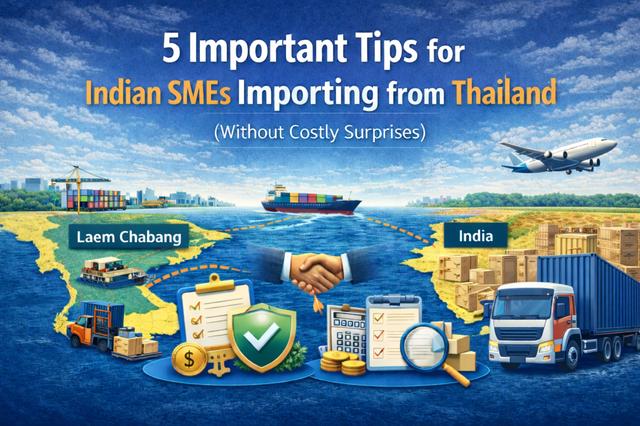
Thailand is a strong sourcing destination for Indian SMEs-especially for categories like auto components, plastics, packaging, consumer goods, electronics accessories, garments, furniture, food ingredients, and lifestyle products. But the real savings (and fewer headaches) come from doing a few fundamentals right before you place that first purchase order.
Here are five practical, India-focused tips to help you import from Thailand smoothly, control landed cost, and reduce compliance risk.
Many first-time importers negotiate a great unit price and then get shocked by the final cost after freight, insurance, duties, port charges, and local handling. For SMEs, this can wipe out margins.
What to do instead:
Estimate landed cost per unit before confirming the order:
Product price (ex-factory / FOB / CIF)
International freight + insurance
Customs duty + applicable taxes (varies by HS code and policy)
Port/terminal handling, CFS charges, CHA fees, documentation
Inland transport + warehousing
Choose an Incoterm that matches your capability
If you’re new, FOB is often easier to control because you arrange freight with an Indian forwarder and can compare rates.
CIF can look convenient but sometimes hides inflated freight/insurance.
Build a buffer for exchange-rate movement and unexpected charges.
SME pro move: Ask your freight forwarder or CHA for a landed cost worksheet using the HS code you plan to declare.
Your HS code drives duties, required licenses, and compliance checks. Misclassification is one of the most common reasons shipments get delayed or end up with additional duty demands.
Practical steps:
Confirm the correct HS code using:
Product composition/material
Use-case/function
Technical specs (especially for electronics/chemicals)
Check product-specific Indian regulations that may apply, for example:
BIS requirements for certain electronics/electrical goods
FSSAI for food items/ingredients
WPC approvals for wireless/Bluetooth-enabled items
Legal Metrology for packaged commodities (labels/MRP declarations where required)
Plant quarantine for certain agricultural/plant-based products
CDSCO for specific medical devices/products
SME pro move: Before shipment, ask your Thai supplier for spec sheets, material declarations, test reports, and clear product descriptions that match the HS classification and compliance needs.
Even when your product is fine, document mismatches cause avoidable delays—especially invoice vs packing list vs bill of lading details.
Core documents you’ll almost always need:
Commercial Invoice (with accurate description, quantity, unit price, Incoterm, currency)
Packing List (weights, carton counts, dimensions)
Bill of Lading / Airway Bill
Insurance certificate (if applicable)
Any test certificates, MSDS (for chemicals), or product compliance documents as needed
If you want preferential duty benefits (where applicable):
Ensure you obtain the correct Certificate of Origin type and that it complies with the relevant trade agreement rules.
Make sure country of origin claims are legitimate (Rules of Origin matter).
Important: Your product description should be consistent across all documents. Vague descriptions (“spare parts”, “accessories”, “gift items”) invite scrutiny.
SME pro move: Create a one-page “Documentation Master Sheet” with:
Correct company name/address (exactly as per IEC/GST records)
Consignee/notify party details
Product description standard text
HS code
Incoterm
Port of loading/discharge
Share it with your supplier and forwarder to keep everyone aligned.
Thai suppliers may ask for advance payment, especially for first orders. Indian SMEs want to reduce risk without losing the deal.
Common payment options (from safer to riskier):
Letter of Credit (LC): Good control for larger orders; more paperwork and bank charges.
Documents against Payment (DP): Payment released when documents are presented; decent balance.
Telegraphic Transfer (TT): Common for SMEs—try to avoid 100% advance on first deal.
Open Account: Usually only after trust is established.
Practical negotiation approach for first orders:
Start with 30% advance + 70% against shipping documents (or against Bill of Lading copy).
For repeat orders, move toward better terms once quality and delivery are consistent.
Include quality acceptance criteria in the PO to avoid disputes.
SME pro move: If the product is quality-sensitive, use pre-shipment inspection (third-party) and link final payment to inspection approval.
Logistics mistakes can turn a profitable import into a costly mess—damage, short shipment, demurrage, or surprise local costs.
Key actions:
Decide shipment mode early
Sea freight for heavier/bulky goods; lower cost but longer lead time
Air freight for high-value or urgent shipments; faster but expensive
Confirm packaging specs
Moisture protection, palletization, carton strength, labeling
Container utilization (to reduce cost per unit)
Insure properly
If you buy FOB/CFR, arrange insurance yourself so you control coverage and claims
Assign responsibilities clearly
Who books freight?
Who pays destination charges?
Who handles customs clearance in India?
Who is responsible for export clearance in Thailand?
SME pro move: Put a simple “Logistics Responsibility Table” in your PO:
Incoterm
Freight booking party
Insurance party
Export docs responsibility
Inspection requirement
Delivery timeline + penalties (where practical)
✅ IEC and GST details confirmed for importer entity
✅ HS code validated and compliance checks done
✅ Incoterm agreed and landed cost calculated
✅ Invoice, packing list, and product description standardized
✅ Certificate of Origin requirement confirmed (if claiming any preference)
✅ Pre-shipment inspection booked (if required)
✅ Freight plan finalized (mode, carrier, transit time, destination charges)
✅ Insurance coverage confirmed
✅ Customs broker/CHA aligned on documents and filing timeline
Ordering based on unit price without a landed cost view
Using vague product descriptions on invoices
Misaligned Incoterms (e.g., thinking CIF means “no destination charges”)
Skipping compliance checks until the cargo arrives
Paying 100% upfront on a first-time supplier without inspection safeguards
The future of freight is becoming more predictive, connected, and digital. This blog explains how AI improves decision-making, IoT expands r...

Growing import businesses often lose time and money through manual freight coordination. This blog uses published SME examples to show how d...

Learn how online freight marketplaces help importers get instant container-shipping quotes, compare options quickly, and improve booking dec...