
Trade Guide
The Future of Freight: AI, IoT & Blockchain in International Shipping
The future of freight is becoming more predictive, connected, and digital. This blog explains how AI improves decision-making, IoT expands r...
Incoterms and contracts shape who pays, who controls the freight, and when risk transfers-often more than the product price itself. This guide explains the most practical Incoterms for Thailand-India imports and the key contract clauses that prevent disputes around documentation, insurance, quality, delays, and unexpected charges. Use it to negotiate clearer, safer terms and build a repeatable import process.
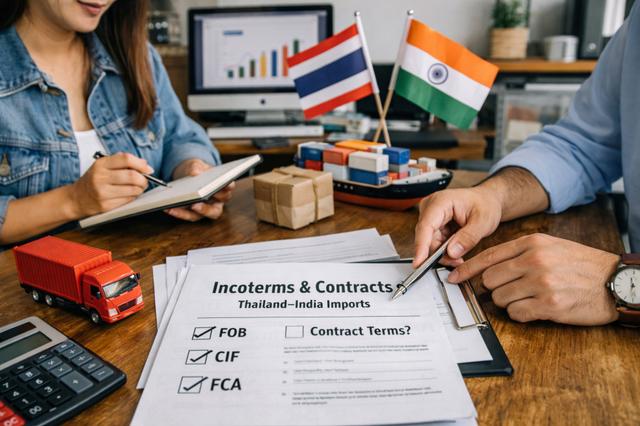
When you import from Thailand into India, the difference between a smooth shipment and a costly dispute often comes down to two things:
The Incoterm you choose, and
How clearly your contract (or PO + supply agreement) defines responsibilities.
Price matters-but terms decide who controls freight, who carries risk, who handles documentation, and who pays when something goes wrong. This blog breaks down the most practical Incoterms for Thailand-India imports and the contract clauses that help you negotiate with confidence.
Incoterms define:
Delivery point (where the seller’s responsibility ends)
Risk transfer (when risk shifts from seller to buyer)
Cost responsibility (who pays which logistics legs)
Export/import responsibilities (varies by term)
Incoterms do NOT define:
Payment terms (advance, LC, credit)
Quality standards and acceptance criteria
Warranties and remedies
Ownership/title transfer
Dispute resolution and governing law
That’s why you should treat Incoterms as the logistics framework, and your contract/PO as the risk-control system.
On this lane, avoidable costs typically come from:
Document mismatches (invoice, packing list, BL/AWB inconsistencies)
Port/terminal delays leading to demurrage/detention
Unclear responsibility when cargo is damaged, short, or delayed
“All-in quotes” that hide exclusions (local charges, surcharges, insurance limits)
Choosing the right Incoterm helps you decide whether you want control (over freight and visibility) or convenience (seller handles more).
| Your Priority | Best-Fit Incoterms | Why it Works |
|---|---|---|
| Control freight cost + schedule | FCA (often best), FOB (common) | You choose forwarder/carrier, get better visibility and cost control |
| Convenience (seller books freight) | CFR/CIF (ocean), CPT/CIP (air/multimodal) | Seller arranges main transport; you manage fewer steps |
| Delivered close to your facility | DAP (most realistic) | Seller delivers to named place; you handle import clearance in India |
| “Delivered duty paid” simplicity | DDP (use carefully) | Can be messy for compliance/tax/importer-of-record; only use with proven structure |
Best for: Regular importers who want control without export-side chaos.
Seller delivers goods to your nominated carrier/forwarder at a named place (factory gate, forwarder warehouse, terminal, etc.).
Risk transfers at that handover.
Why FCA is strong on Thailand-India trade:
Cleaner handover point for container freight
You control main freight and visibility
Seller can still support export-side delivery
Typical wording:
“FCA Bangkok (named forwarder warehouse), Incoterms 2020”
Best for: Buyers who want control but are used to FOB quoting.
Seller is responsible until goods are on board the vessel at the named port.
Risk transfers once loaded.
Use FOB when:
Your suppliers and your internal process are set up around FOB, and
You specify port + documentation + handover clarity so there’s no “responsibility gap.”
Typical wording:
“FOB Laem Chabang Port, Incoterms 2020”
Best for: Low volume or first-time imports when you want simplicity.
CFR: seller pays ocean freight; risk transfers at loading (like FOB risk point).
CIF: CFR + seller provides insurance (often basic unless you specify better coverage).
Key watch-outs:
Less control over carrier, routing, schedules, and local charges
CIF insurance may be minimal unless clearly defined
Typical wording:
“CIF Nhava Sheva (JNPT), Incoterms 2020”
Best for: Air shipments Thailand → India, or when you want seller-arranged carriage.
CPT: seller pays carriage to named destination; risk transfers when handed to carrier.
CIP: CPT + seller provides insurance.
Watch-outs:
The named destination must be precise (airport/ICD/warehouse).
Risk transfers earlier than many buyers assume.
Best for: Importers who want convenience but still want control over Indian customs.
Seller delivers to a named place (ICD, warehouse, etc.).
Buyer handles import clearance and duties.
Why DAP is often better than DDP:
You keep compliance and duty/tax control in India.
Fewer “who is importer-of-record?” complications.
EXW makes you responsible for almost everything from the supplier’s door. It can work, but it increases coordination complexity—especially for export handling and document control.
If you’re offered EXW, try to negotiate to FCA.
A correct Incoterm line includes:
Incoterm rule (FCA/FOB/CIF/etc.)
Named place/port (specific)
Incoterms version (usually Incoterms 2020)
Good examples:
“FCA Bangkok (ABC Forwarder Warehouse), Incoterms 2020”
“FOB Laem Chabang Port, Incoterms 2020”
“CIP Chennai Airport, Incoterms 2020”
“DAP ICD Tughlakabad, Incoterms 2020”
Avoid vague terms like:
“FOB Thailand”
“CIF India”
“Delivered to warehouse” (which warehouse? unloaded or not?)
Think of your contract as your “prevention system.” These are the clauses that stop cost leaks and disputes.
Include:
Final specifications with revision/version control
Approved sample reference (“golden sample”)
Clear acceptance criteria (critical/major/minor defects)
Inspection rights (pre-production / during / pre-shipment)
Why this matters: If quality isn’t measurable, every problem becomes an argument.
Define:
Carton strength / packaging method
Palletization rules (if used), wrapping, moisture protection
Carton markings, SKU labels, barcode/label format
Any destination-market labeling requirements (as applicable)
Why this matters: Damage claims often fail due to poor packaging and unclear standards.
Specify the exact documents required, such as:
Commercial invoice
Packing list (weights/dimensions/carton count + SKU mapping)
BL/AWB details and consignee instructions
Insurance certificate (for CIF/CIP)
Product-specific documents as applicable (test reports, MSDS, etc.)
Add a practical rule:
Supplier must send pre-alert documents for buyer review before dispatch.
This single step prevents many customs and clearance delays.
Include:
When lead time starts (PO date? advance received? artwork approval?)
“Ready to ship” definition
Partial shipment rules (allowed/not allowed)
What happens if delays occur (notice timelines and remedies)
For new suppliers, a safer structure is often:
Part advance to start production
Balance after passing inspection / pre-shipment checks (or against shipping documents)
The goal: don’t pay 100% before you have proof of compliance—and don’t push terms so hard that you become a low-priority customer.
Even when insurance is included (CIF/CIP), specify:
Minimum coverage expectation (and any exclusions you won’t accept)
Claims notification timeline
Evidence needed (photos, survey report, packing proof)
Responsibility for packaging-caused damage
Define who pays if delays are caused by:
Incorrect/incomplete documents
Late document submission
Errors in consignee/notify party details
Mis-declared quantities/weights
This clause is especially valuable when sellers control freight (CFR/CIF/CPT/CIP/DAP).
Include:
Governing law
Dispute forum (court or arbitration)
Language and location for arbitration (if used)
This reduces negotiation friction when something goes wrong.
Ask for your quote in two comparable versions:
FCA/FOB (you control freight)
CIF/CIP or DAP (seller controls freight)
This quickly reveals hidden cost drivers.
“Packaging will be strong” → carton spec + pallet rules
“We will insure it” → coverage + claims process
“Documents will be fine” → templates + pre-alert review deadline
First order: tighter controls (inspection + clear milestones)
Later orders: streamline once supplier performance is consistent.
Require:
Production updates (weekly cadence)
Booking confirmation (vessel/flight, ETD/ETA)
Pre-alert documents before dispatch
Tracking updates until delivery/ICD handover
Visibility prevents delays-and makes problem-solving faster.
Use these as PO add-ons (not legal advice):
Incoterms clause:
“Delivery terms shall be FCA [named place], Incoterms 2020. Risk transfers upon delivery to the carrier at the named place.”
Documentation clause:
“Seller shall provide commercial invoice, packing list, and shipment pre-alert documents for Buyer review prior to dispatch. Documents must match PO number, item description, quantities, weights, and consignee details.”
Inspection clause:
“Buyer or Buyer’s nominated inspector may conduct pre-shipment inspection. Non-conforming goods shall be reworked/replaced by Seller. Re-inspection due to non-conformance shall be borne by Seller.”
Incoterm + named place/port + “Incoterms 2020” written correctly
Specs/version + packaging requirements finalized
Payment milestones aligned to inspection and dispatch
Documentation list agreed + templates shared
Booking confirmed (ETD/ETA, vessel/flight details)
Packing list matches actual cartons/pallets
Invoice matches PO, buyer details, currency, and item descriptions
Pre-alert documents reviewed and corrected (if needed)
Inspect on receipt immediately (counts + photos)
Record discrepancies quickly for claims
Run a post-shipment review with supplier (root cause + corrective actions)
Choosing EXW without export-process clarity → prefer FCA
Writing “FOB Thailand” / “CIF India” → always name port/place + Incoterms 2020
Assuming CIF/CIP insurance is comprehensive → define coverage and claims steps
No document-review step → require pre-alert review before dispatch
No rule for demurrage/detention → define who pays if delays are document-related
The future of freight is becoming more predictive, connected, and digital. This blog explains how AI improves decision-making, IoT expands r...

Growing import businesses often lose time and money through manual freight coordination. This blog uses published SME examples to show how d...

Learn how online freight marketplaces help importers get instant container-shipping quotes, compare options quickly, and improve booking dec...