
Trade Guide
The Future of Freight: AI, IoT & Blockchain in International Shipping
The future of freight is becoming more predictive, connected, and digital. This blog explains how AI improves decision-making, IoT expands r...
FCL and LCL are two common ocean freight options, but the best choice depends on your shipment size, urgency, risk tolerance, and budget. This guide explains how each works, compares costs and timelines, and helps you decide using a simple, practical framework.
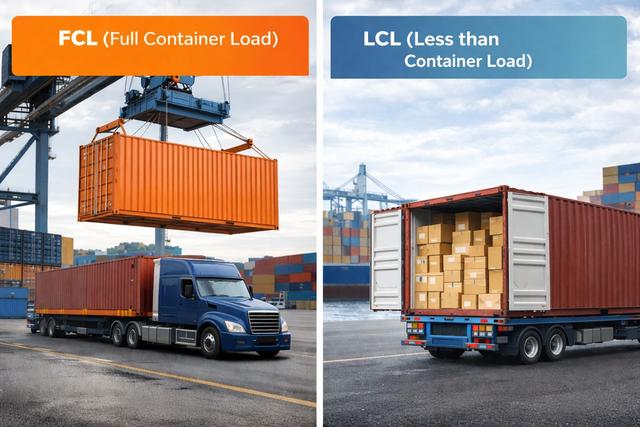
Choosing between FCL (Full Container Load) and LCL (Less than Container Load) can feel like a simple volume decision-but it affects cost, transit time, risk, inventory planning, and customer experience. The right option depends on how much you’re shipping, how often, how time-sensitive your cargo is, and how much complexity you’re willing to manage.
This guide breaks down FCL and LCL in plain terms, compares them side-by-side, and gives you a practical framework to decide.
FCL means your shipment occupies an entire ocean container-even if you don’t fill it 100%. The container is typically sealed at origin and opened at destination (or at a final delivery point), with fewer touchpoints in between.
Best for: larger shipments, time-sensitive cargo, high-value goods, and businesses that prefer predictability.
LCL means your goods share a container with other shippers’ cargo. Your freight forwarder consolidates multiple shipments into one container at origin and deconsolidates them at destination.
Best for: smaller shipments, irregular shipping volumes, and businesses optimizing cash flow by shipping smaller batches.
| Factor | FCL | LCL |
|---|---|---|
| How you pay | Mostly by container | Mostly by volume (CBM) and/or weight |
| Transit time reliability | Usually higher | Often lower (more handling + consolidation steps) |
| Risk of damage/loss | Typically lower | Typically higher (more touchpoints) |
| Flexibility | Great for consistent volume | Great for smaller, frequent shipments |
| Customs and paperwork | Often simpler per shipment | More coordination (house and master documentation) |
| Handling | Less handling | More handling (consolidation/deconsolidation) |
| Storage/demurrage risk | Can be lower if planned well | Can rise if deconsolidation causes delays |
With FCL, you’ll generally see charges like:
Ocean freight (per container)
Origin/destination terminal handling
Documentation fees
Haulage/trucking to/from the port (if applicable)
Possible surcharges (fuel-related, seasonal, port congestion, etc.)
FCL tends to win on cost per unit once your shipment reaches a certain volume because you’re spreading container-level charges across more goods.
With LCL, costs often include:
Freight rate per CBM (and sometimes weight-based minimums)
Consolidation and deconsolidation fees
Terminal handling fees at both ends
Documentation fees
Potential “minimum charge” thresholds (you may pay for a minimum CBM even if you ship less)
LCL tends to win for small volumes because you avoid paying for unused container space.
In many trade lanes, LCL can be economical for small shipments, but once you hit a mid-range volume, FCL often becomes more cost-effective.
A common planning heuristic:
Very small shipments (e.g., 1-8 CBM): LCL is often more economical
Mid-range (e.g., 10-15+ CBM): compare carefully-this is often the “break-even” zone
Larger shipments: FCL is frequently the better value
Important: break-even varies widely by route, season, carrier capacity, and local fees. Always compare quotes using the same assumptions (Incoterms, pickup/delivery scope, chargeable weight, and ready date).
FCL typically involves:
Fewer warehouse stops
Less waiting for consolidation
Less handling at destination before release
If your cargo is time-sensitive, FCL often reduces schedule risk-especially when ports are congested.
LCL adds steps:
Your cargo must arrive by the consolidator’s cutoff time
It must be grouped with other shipments
It’s unloaded and separated at destination before final release
Even if the vessel transit is the same, the end-to-end lead time can be longer.
Because your shipment is handled less and sealed into a dedicated container, FCL generally reduces exposure to:
Mis-sorting
Crushing (from other cargo in shared containers)
Cross-contamination (odors, spills)
Pilferage opportunities
LCL isn’t “unsafe,” but it does typically involve:
More loading/unloading events
Stacking constraints and mixed cargo considerations
Higher dependency on packaging quality
If you ship fragile goods, high-value items, or products sensitive to odor/moisture, you’ll want to assess whether LCL’s extra handling is worth the savings.
Choose FCL when:
Your shipment volume is consistently high or trending upward
You need better transit reliability
Your cargo is high value, fragile, or sensitive
You want simpler handling and fewer intermediaries
You’re planning promotions, seasonal demand, or tight delivery windows
You want the option of special equipment (e.g., reefer for temperature-controlled cargo, open top, flat rack)
Common FCL scenarios
Retail replenishment shipments for a set delivery window
Manufacturing inputs where delays stop production
High-value electronics, branded goods, or fragile items
Choose LCL when:
Your volume is small and not enough to justify a full container
You ship frequently in smaller batches to protect cash flow
You’re testing a new market and want lower commitment per shipment
You have storage constraints and prefer smaller, more frequent deliveries
Common LCL scenarios
New exporters shipping trial orders
SMEs restocking ecommerce inventory in small batches
Spare parts and accessories where demand is uneven
While exact usable capacity depends on packaging, pallet size, and stowability, typical internal capacity estimates are:
20-foot container: ~33 CBM
40-foot container: ~67 CBM
40-foot high cube (40HC): ~76 CBM
If your cargo is bulky but light, you may hit space limits first (CBM). If it’s dense, weight limits may become the constraint even before the container is “full.”
Small: LCL tends to be simpler on budget
Mid-range: compare both (this is where surprises happen)
Large: FCL usually wins
Tight deadlines → lean FCL
Flexible timelines → LCL can work well
Fragile, high-value, regulated, moisture/odor-sensitive → FCL often safer
Durable, well-packaged → LCL can be fine
Weekly or predictable volume → FCL can streamline operations
Irregular orders → LCL can avoid wasted space and cost
Want fewer handoffs and simpler coordination → FCL
Want lower shipment-level commitment → LCL
Regardless of which you choose, avoid comparing quotes based only on the headline ocean rate. Ask what’s included and confirm:
Minimum charge policies (LCL): you may pay for a minimum CBM
Warehouse cutoffs (LCL): missing cutoffs can push you to the next sailing
Destination fees: these can be significant; confirm them upfront
Customs exams and inspections: can impact both, but LCL may face delays during deconsolidation
Packaging standards: LCL often demands stronger packaging due to stacking and handling
Demurrage/detention exposure: poor planning can make either option expensive fast
If most of these are true, choose FCL:
Volume is consistently high or near container capacity
Late delivery would cause major business impact
Cargo is fragile/high value/sensitive
You prefer fewer touchpoints and more control
If most of these are true, choose LCL:
Volume is small and irregular
You want to ship smaller batches more frequently
You’re optimizing working capital
Delivery timelines are flexible
Not always, but FCL is often more predictable end-to-end because it avoids consolidation and deconsolidation steps.
Often, yes-but not always. LCL has minimum charges and local fees that can make it less competitive in the mid-range CBM zone.
The biggest operational risks are usually extra handling and timeline variability caused by consolidation schedules and destination deconsolidation.
Sometimes, but availability is limited and lane-dependent. If temperature control is critical, FCL reefer is usually the safer, more controlled option.
FCL is typically best when you value speed, predictability, and reduced handling risk-especially at higher volumes.
LCL is typically best when you value flexibility and cost control for smaller shipments.
The future of freight is becoming more predictive, connected, and digital. This blog explains how AI improves decision-making, IoT expands r...

Growing import businesses often lose time and money through manual freight coordination. This blog uses published SME examples to show how d...

Learn how online freight marketplaces help importers get instant container-shipping quotes, compare options quickly, and improve booking dec...