
Trade Guide
The Future of Freight: AI, IoT & Blockchain in International Shipping
The future of freight is becoming more predictive, connected, and digital. This blog explains how AI improves decision-making, IoT expands r...
A practical guide to building resilience using lessons from the global shipping crisis and supply chain disruptions.
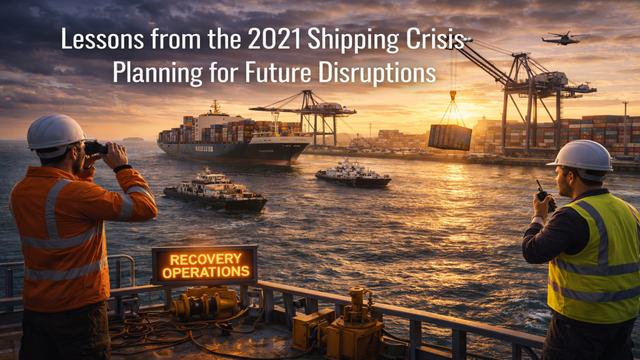
The 2021 shipping crisis is still relevant because it changed what importers should treat as “normal risk.”
UNCTAD said freight rates had reached historical highs by end-2020 and early 2021, driven by demand recovery, equipment shortages, carrier capacity management, and pandemic-related intermodal delays. Its 2021 Review of Maritime Transport also noted that the Ever Given grounding in March 2021 pushed freight rates even higher after the Suez Canal closure. The World Bank later said the pandemic disruptions of 2021–2022 were significant enough to trigger the creation of a Global Supply Chain Stress Index in 2021.
The macro lesson was equally clear. IMF research found that when freight rates double, inflation rises by about 0.7 percentage point, and it estimated that the 2021 shipping-cost surge could add about 1.5 percentage points to inflation in 2022.
That is why the better importer question is not, “Could 2021 happen again in the same way?” It is, “What did 2021 teach us about how quickly freight, inventory, and working capital can all move together when networks break?”
The 2021 crisis was unusual, but the pattern did not disappear.
UNCTAD warned again in 2024 that Suez and Panama Canal disruptions were reshaping trade patterns and raising costs. Sea-Intelligence’s January 2026 data still showed schedule reliability at only 62.4% with late vessels averaging 5.17 days late, which means perfect stability never really returned. The point is not that 2021 repeats exactly. The point is that supply-chain shocks now come from pandemics, chokepoints, droughts, war, labour issues, and policy shocks—not from just one source.
The first lesson is that freight is not a stable background cost.
UNCTAD’s 2021 and 2025 work shows how quickly freight markets can jump when demand and network disruption collide. IMF’s work on shipping-cost inflation shows why this matters beyond the freight bill itself: higher shipping costs feed into import prices, producer prices, and consumer inflation over time. For importers, that means old freight assumptions should never sit untouched in annual budgets.
The second lesson is about concentration.
The WTO’s 2021 World Trade Report said the global trading system is both vulnerable and resilient, and that trade can support resilience by enabling diversification. The pandemic showed the same thing practically: when goods, suppliers, and lanes are too concentrated, even one blockage or shortage has a bigger commercial effect. That does not mean abandoning efficient sourcing. It means building enough optionality that one weak node does not stop the business.
The third lesson is that late awareness is expensive.
The World Bank’s GSCSI and the New York Fed’s GSCPI both exist because disruptions need to be measured before they become anecdotal. Maersk’s current resilience guidance says monitoring global risks helps businesses predict and respond to shocks more effectively. In practical importer terms, that means visibility should be built around early warning, not just after-the-fact status updates.
The fourth lesson is that inventory and finance are part of logistics resilience.
The 2021 crisis showed that cargo can move late, cost more, and force emergency expediting at the same time. IMF’s inflation work and UNCTAD’s freight-rate analysis both show how broad the economic effect can become once transport cost spikes. The lesson for importers is not “hold maximum stock everywhere.” It is “protect the right SKUs with enough inventory and financing resilience that freight volatility does not immediately become a service failure.”
The fifth lesson is that international disruption is only half the problem.
CBIC’s National Time Release Study 2025 shows seaport import release time at 79:04 hours on average, with advance filing at 71:23 hours and late filing at 158:59 hours. In other words, an importer can survive a global freight shock and still lose time domestically through documentation and release issues. Crisis resilience is not only about ocean planning. It is also about border and inland discipline.
The businesses that should remember 2021 most clearly are the ones where one disrupted lane quickly becomes lost revenue or lost output.
That includes lean-inventory importers, electronics and component buyers, machinery and spare-part importers, project-driven cargo owners, and businesses that rely on air freight as an emergency correction tool. This follows directly from the interaction between delay, cost spikes, and stockout risk that 2021 exposed.
Use this as a standing resilience checklist:
Update freight assumptions more often than your annual budget cycle.
Separate critical SKUs from routine replenishment.
Keep alternate carrier, route, and mode options ready in advance.
Monitor risk indicators, not just shipment ETAs.
Build customs-document discipline into disruption planning.
Preserve working-capital room for emergency freight or extra stock.
Avoid one-country or one-supplier dependence on critical inputs.
Decide which goods deserve air fallback before delays begin.
Share risk visibility across procurement, logistics, finance, and sales.
Test your contingency plan before a crisis makes it urgent.
These are the common post-2021 mistakes:
assuming the crisis was a once-in-a-generation anomaly
rebuilding supply chains for efficiency only
watching rates but not reliability
treating inventory and freight as separate decisions
ignoring customs and inland execution during disruption planning
Cogoport’s official pages position the platform around instant freight quotes, tracking and visibility, rates and schedules, Cogo Assured, and Pay Later. In a disrupted market, that matters because buyers need faster re-quoting, better shipment visibility, and more flexibility when freight and inventory pressures hit at the same time.
The biggest lesson from 2021 is not that shipping can become expensive. Importers already know that. The bigger lesson is that when freight markets break, they can also break inventory assumptions, delivery promises, inflation assumptions, and cash-flow plans at the same time.
That is what makes 2021 useful as a planning case study today. The exact trigger may change, but the commercial pattern remains familiar: concentration hurts, visibility matters, buffers matter, and customs readiness still counts. The importers who keep those lessons alive in their operating model will usually recover faster from the next disruption than the ones who file 2021 away as history.
UNCTAD, “Container shipping in times of COVID-19: Why freight rates have surged and implications for policymakers.” Used for historical-high freight-rate context and pandemic drivers.
UNCTAD, Review of Maritime Transport 2021. Used for 2021 freight-rate dynamics and service-disruption framing.
UNCTAD, RMT 2021 chapter on freight rates and maritime transport costs. Used for the late-2020/2021 freight-rate surge context.
UNCTAD, “Suez and Panama Canal disruptions threaten global trade and development” (2024). Used for the point that large network shocks keep recurring.
World Bank, Global Supply Chain Stress Index. Used for the creation of a shipping-stress measure after the 2021–22 disruptions.
World Bank, “A Metric of Global Maritime Supply Chain Disruptions.” Used for the broader GSCSI methodology context.
IMF, “How Soaring Shipping Costs Raise Prices Around the World.” Used for the 0.7 percentage point inflation effect and 1.5-point 2022 estimate.
IMF, “Shipping Costs and Inflation,” WP/22/61. Used for the broader empirical link between freight shocks and inflation.
WTO, World Trade Report 2021: Economic resilience and trade. Used for the resilience/diversification framing.
Federal Reserve Bank of New York, Global Supply Chain Pressure Index. Used for current risk-monitoring context.
Sea-Intelligence, “2026 starts with Global Schedule Reliability of 62.4%.” Used for current reliability and delay figures.
Maersk, “Monitoring global risks in the supply chain” (2 May 2025). Used for current resilience-monitoring guidance.
DHL, “How to deal with overseas shipping delays” (4 Dec 2025). Used for response and expectation-management context.
CBIC / PIB, National Time Release Study 2025. Used for seaport ART, advance filing, and late filing.
Cogoport, official platform, rates, tracking, Cogo Assured, and Pay Later pages. Used for current Cogoport product references.
The future of freight is becoming more predictive, connected, and digital. This blog explains how AI improves decision-making, IoT expands r...

Growing import businesses often lose time and money through manual freight coordination. This blog uses published SME examples to show how d...

Learn how online freight marketplaces help importers get instant container-shipping quotes, compare options quickly, and improve booking dec...