
Trade Guide
The Future of Freight: AI, IoT & Blockchain in International Shipping
The future of freight is becoming more predictive, connected, and digital. This blog explains how AI improves decision-making, IoT expands r...
The ASEAN-India Free Trade Agreement (AIFTA) can significantly lower duty costs for imports from Thailand-if your HS classification, eligibility, Rules of Origin, and documentation align correctly. This practical guide explains how to validate origin, manage direct consignment requirements, secure an accurate Form AI certificate, and build a repeatable compliance process to claim preferential tariffs without clearance delays.
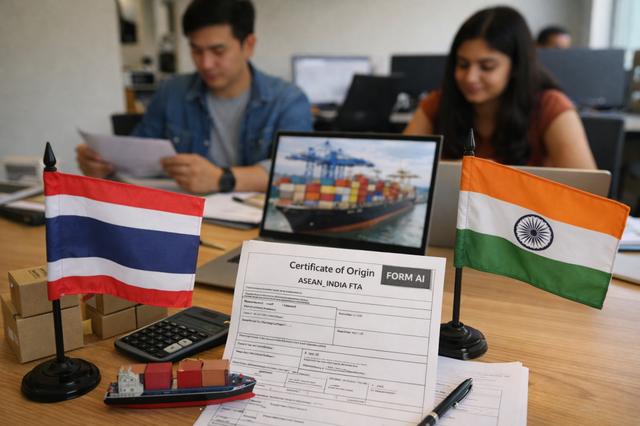
Importing from Thailand into India can be significantly more cost-effective when you correctly use the ASEAN-India Free Trade Agreement (AIFTA). The keyword is correctly-because FTA savings don’t come from paperwork alone. They come from aligning four things end-to-end:
Right HS classification
Product eligibility under the FTA rate schedule
Rules of Origin compliance (how/where the product is made)
Clean documentation + claim process at Indian Customs
This guide is a practical playbook to help you reduce duty costs while keeping your shipments compliant and clearance-friendly.
AIFTA’s primary benefit is preferential customs duty on eligible goods that qualify as “originating” under the agreement.
In most cases, importers see savings mainly through:
Reduced Basic Customs Duty (BCD) (the big lever)
Reduced downstream impact where other charges are computed with reference to customs duties (depending on the product and duty structure)
What AIFTA usually does not eliminate by itself:
Domestic taxes applicable on import (which depend on your product category and India’s tax framework)
Compliance requirements, import licenses, product standards, labeling rules, etc.
Practical takeaway: AIFTA is a duty-reduction tool, not a shortcut around compliance.
If you only remember one thing, make it this:
FTA savings are approved when “classification + eligibility + origin + documentation” all match.
If even one element is off-wrong HS code, incorrect origin criterion, missing consignment proof-preferential duty may be denied and your shipment can face delays, queries, or post-clearance scrutiny.
Before you talk to suppliers about certificates, confirm your India-side HS classification.
Why this matters:
The preferential rate you’re trying to claim is tied to the HS code
Rules of origin can vary by HS code (especially if product-specific rules apply)
Even small description differences can shift classification
Confirm the HS code at the 8-digit level used in India
Lock a consistent product description that matches:
purchase order
invoice
packing list
certificate of origin
bill of entry
Not all products get the same tariff benefit under FTAs. Some may have:
Partial concessions
Long phase-down schedules
Sensitive treatment
Exclusions
So, confirm your specific HS code’s preferential rate and any conditions that may apply.
To get AIFTA benefits, goods must qualify as originating in Thailand (or another eligible ASEAN party), based on how they’re produced and what inputs are used.
There are typically three broad ways goods qualify:
These are products that are entirely obtained/produced in the exporting country (examples can include certain agricultural, mineral, or natural products depending on the detailed definitions).
On the certificate, this is typically indicated as “WO.”
For many manufactured products, the typical qualification route is:
Minimum regional content threshold, and
A tariff classification change requirement for non-originating inputs
In practice, many products qualify if:
AIFTA content is at least 35% of FOB value, and
Non-originating materials undergo a change in tariff sub-heading (CTSH)
Think of it like this:
You can use some non-ASEAN inputs, but not too much, and the manufacturing must be substantial enough that the classification meaningfully changes.
Some HS lines have product-specific origin rules that override the general rule. This is common in sensitive or complex product categories.
Practical takeaway: Don’t assume the same origin logic applies to every product. Confirm whether your HS line relies on a PSR.
AIFTA includes the concept of cumulation, which can be powerful for Thailand-based manufacturers who source inputs from multiple ASEAN countries.
What it means in practice:
If a Thai supplier uses qualifying originating materials from another AIFTA party, those inputs can be treated as “originating” when calculating origin.
Why it matters: Cumulation can help manufacturers meet the required regional content threshold without changing the final product or compromising on components.
A common compliance pitfall is assuming that light processing in Thailand makes the product “Thai origin.”
Under typical FTA frameworks, minimal operations (like simple packing, labeling, repacking, basic mixing, or similar low-value steps) do not confer origin on their own.
Practical takeaway: If your product is basically “imported into Thailand and repacked,” your FTA claim is high-risk.
Even if the product qualifies by origin, you still need to meet consignment/transport conditions.
The cleanest approach is:
Ship directly from Thailand to India, with documentation that supports the route.
If your shipment is routed through a non-AIFTA country for transshipment or storage, you generally need to ensure:
the transit is justified by geography/logistics,
the goods do not enter commerce there, and
the goods are not processed beyond what is needed to keep them in good condition (typically unloading/reloading or preservation).
Operational tip: If you expect transshipment (e.g., via a major hub), instruct your forwarder in advance to preserve a documentation trail that supports compliant transit.
To claim preferential tariffs under AIFTA, the proof document is typically the Certificate of Origin (C/O) Form AI.
Before the cargo departs Thailand, verify the certificate includes:
exporter details (matching your supplier’s legal name/address)
consignee details (matching your importer entity)
transport details and route (as far as known)
clear goods description + package details
the HS number used by the importing country
FOB value
invoice number/date reference where applicable
the correct origin criterion (e.g., “WO” or the relevant qualifying statement)
proper stamps/signatures, no unauthenticated alterations
correct tick-boxes where relevant (such as third-country invoicing, back-to-back CO, cumulation)
Practical tip: Many import issues come from “small mismatches”-HS code mismatch, invoice mismatch, or unclear origin criterion. Build a pre-shipment document review step into your SOP.
Claiming preferential duty is not only the exporter’s job. Under India’s framework, the importer must be able to demonstrate that the goods meet the origin criteria and must keep supporting information ready.
Claim the preferential rate correctly at the time of filing your import documents
Ensure certificate details are captured accurately
Maintain an internal “origin file” (more on this below)
Be ready to respond to customs queries with a clear audit trail
Practical mindset: Don’t treat Form AI as a standalone paper. Treat it as the “cover page” of your origin story.
If you import regularly from Thailand, build a repeatable compliance pack per supplier + HS code. This makes every next shipment smoother.
Final HS classification (internal note + reasoning)
Supplier declaration of origin route (WO / RVC+CTSH / PSR)
Basic bill of materials (high level is often sufficient for importer records)
Manufacturing process summary (what is done in Thailand)
Cost/value summary to support regional content logic (as appropriate)
Sample Form AI template filled correctly (for future consistency)
“Direct consignment” routing instructions for your forwarder
A master document checklist:
invoice
packing list
BL/AWB
Form AI
insurance certificate (if applicable)
any product compliance certificates (if applicable)
In your PO or supply agreement, include:
supplier obligation to provide a valid Form AI
supplier obligation to support verification if authorities request clarification
responsibility for costs arising from incorrect origin documentation (commercially negotiated)
This turns “FTA compliance” into a managed process, not a recurring fire drill.
Here are the issues that most often lead to denial or delay:
HS code mismatch between Form AI and Bill of Entry/invoice
Wrong or vague origin criterion (Box 8 not aligned to how goods qualify)
Certificate has unauthenticated corrections/alterations
Goods shipped via a route that breaks direct consignment conditions
Supplier uses mostly non-ASEAN inputs and cannot support regional content threshold
Product only undergoes minimal operations in Thailand
Third-country invoicing scenario exists but is not properly indicated/documented
Importer claims preference but cannot provide supporting origin information when asked
Rule of thumb: If you can’t explain “why this is originating” in 2-3 clear sentences backed by documents, your claim is fragile.
Before you decide to pursue AIFTA for a product, do a quick commercial check:
Identify your current normal duty (non-preferential) scenario
Identify the preferential duty under AIFTA for that HS code
Estimate savings on:
Basic Customs Duty difference
Any dependent charges impacted by that duty (varies by structure)
Why this matters: This helps you decide if it’s worth investing time in origin documentation and supplier alignment.
If you’re starting from scratch, this workflow is realistic:
Week 1: Setup
confirm HS code + product eligibility
align with supplier on origin qualification route
create document templates and a “pre-shipment doc review” SOP
Week 2: Trial shipment discipline
request Form AI draft early
validate route/consignment plan
ensure invoice/packing list/HS/origin criterion alignment
Week 3 onwards: Scale
build your origin dossier per supplier and HS code
standardize everything (same templates, same checks, same process)
The future of freight is becoming more predictive, connected, and digital. This blog explains how AI improves decision-making, IoT expands r...

Growing import businesses often lose time and money through manual freight coordination. This blog uses published SME examples to show how d...

Learn how online freight marketplaces help importers get instant container-shipping quotes, compare options quickly, and improve booking dec...