
Trade Guide
Success Story: SME Saves Time & Money with a Digital Logistics Solution
Growing import businesses often lose time and money through manual freight coordination. This blog uses published SME examples to show how d...
The future of freight is becoming more predictive, connected, and digital. This blog explains how AI improves decision-making, IoT expands real-time shipment visibility, and blockchain-backed digital trade tools reduce friction in international shipping.
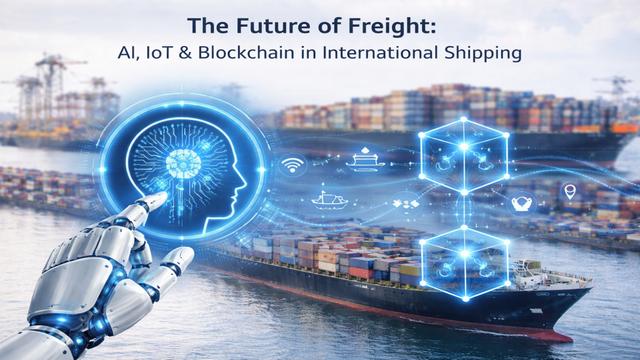
The future of freight is increasingly being built around three digital layers: AI for better decisions, IoT for richer real-time data, and blockchain or standards-based digital trade tools for more trusted document flows. UNCTAD has been arguing for years that artificial intelligence, blockchain, the Internet of Things, and automation are becoming increasingly relevant to maritime transport because they optimize processes, create new business opportunities, and transform supply chains. Its 2024 maritime outlook also called for faster investment in digital tools like AI and blockchain to streamline port operations, reduce congestion, and improve supply-chain efficiency.
The industry is moving in that direction with increasingly concrete commitments. DCSA’s 2026 roadmap says track-and-trace is being expanded to include reefer and IoT events, including direct API access to temperature, humidity, and atmospheric data from refrigerated containers, while end-to-end data handoffs are being designed to run from the first declaration to final invoicing and import release. DCSA’s eBL initiative also says its member carriers are committed to issuing 50% of bills of lading digitally within five years and 100% by 2030.
International shipping still works with emails, PDFs, couriered documents, and manual exception handling. But the gap between “working” and “working well” is widening. DCSA’s Bill of Lading standard is designed to eliminate paper and manual intervention from B/L processes and says standardised digital B/L data can improve efficiency, reduce costs, increase accuracy, strengthen fraud prevention, and make supply chains more resilient. That means the digital future of freight is not only about automation for its own sake. It is about removing trade friction from the parts of shipping that still slow cargo down.
1) AI is shifting shipping from reactive to predictive.
MSC’s AI overview says AI can improve everything from inventory management and supply-chain logistics to fleet management, route optimization, and cargo load planning. CMA CGM’s April 2025 partnership with Mistral AI shows how large carriers are now investing directly in AI to improve shipping and logistics operations, including customer-service workflows. The larger theme is that AI is moving beyond dashboards into decision support.
2) IoT is making containers much more informative.
MSC’s iReefer launch is one of the clearest current examples. The company says customers can now receive real-time information on position, temperature, humidity, and more, either through myMSC or API. DCSA’s 2026 roadmap shows the same direction at a standards level, with reefer and IoT events becoming part of the broader track-and-trace design. For shippers, that means containers are becoming data-generating assets, not only metal boxes.
3) Blockchain-backed digital documents reduce trade friction.
UNCTAD has said blockchain initiatives can support cargo tracking, end-to-end supply-chain visibility, smart contracts, marine insurance integration, and the digitization of paper filings and documents. DCSA’s eBL standard is not branded as “blockchain only,” but it is aligned with the same broader digital-trade shift: straight-through processing, less paper, more security, and better interoperability. In practice, that makes blockchain and standards-based eBL development part of the same long-term friction-reduction trend.
4) Digital trade documentation is becoming a strategic priority.
DCSA says full eBL adoption could unlock around $18 billion in ecosystem gains plus $30–40 billion in global trade growth by reducing document friction and human error. The 100% eBL initiative and MSC’s own commitment to 100% eBL adoption by 2030 show that carriers no longer treat this as an optional experiment. The future of freight will increasingly depend on whether documents move as efficiently as containers do.
5) The freight future will be more integrated, not just more digital.
The most important shift may be interoperability. DCSA’s roadmap is built around end-to-end data handoffs. UNCTAD’s maritime digitalization work also stresses that new technologies matter because they transform supply chains, not only individual tasks. That means the real future is not a pile of disconnected digital tools. It is a more connected trade ecosystem where booking, documentation, tracking, and release data interact with each other more naturally.
The importers who should pay closest attention are the ones with high shipment counts, cold-chain exposure, complex documentation, or multi-party trade flows. Electronics, chemicals, reefer cargo owners, and businesses with many bills of lading or partner handoffs will usually see digital freight innovations earlier because that is where data, documents, and exceptions create the most friction today. That is an inference, but it follows directly from the industry use cases cited above.
Use this as a future-readiness checklist:
These are the common future-of-freight mistakes:
Cogoport fits into this shift because its platform already brings together many of the digital behaviors that freight is moving toward: instant freight-rate discovery, online booking, real-time tracking, end-to-end execution, customs-linked workflows, and digital financial services through Pay Later. CogoAI adds an AI-shaped interface for checking lanes, rules, schedules, and shipment information more quickly, while the wider platform reduces the need to manage booking, visibility, and document coordination in disconnected systems. Cogo Assured adds more predictable execution through fixed pricing and assured fulfillment, which is important because digital freight only becomes valuable when it leads to better commercial control. For importers, that means the future of freight is not some distant concept; parts of it are already visible in how digital platforms are structuring rate discovery, execution, and shipment visibility today. That makes the transition easier to adopt in stages rather than all at once.
The future of freight is not one technology. It is the combination of predictive intelligence, sensor-rich shipment data, and more trusted digital trade documents working together across the shipment lifecycle. AI improves decisions, IoT improves visibility, and blockchain-backed or standards-based digital trade tools improve trust and document speed. The importers who prepare for those changes early will usually be better positioned to reduce friction, react faster, and operate with more control as international shipping becomes more digital and more connected.
Growing import businesses often lose time and money through manual freight coordination. This blog uses published SME examples to show how d...

Learn how online freight marketplaces help importers get instant container-shipping quotes, compare options quickly, and improve booking dec...

Customs clearance moves faster when importers use digital tools for filing, tracking, duty calculation, and document control. This blog expl...