
Trade Guide
The Future of Freight: AI, IoT & Blockchain in International Shipping
The future of freight is becoming more predictive, connected, and digital. This blog explains how AI improves decision-making, IoT expands r...
A simple, practical breakdown of the most common Incoterms for first-time importers-EXW, FOB, and CIF-covering responsibilities, costs, risk transfer, and how to choose the best term for your shipment.
If you’re importing for the first time, Incoterms can feel like shipping “secret code.” But they’re actually a simple tool: Incoterms define who does what, who pays for what, and when risk transfers from seller to buyer.
This guide explains the three most common terms new importers run into-EXW, FOB, and CIF-with plain-language examples and a quick decision framework so you can choose the right one for your shipments.
Responsibilities: who books transport, who handles export clearance, who buys insurance, etc.
Costs: who pays which parts of the logistics chain.
Risk transfer point: when the buyer becomes responsible if goods are damaged or lost.
Title/ownership transfer (that’s in your sales contract and payment terms)
Payment terms (e.g., deposit, LC, net terms)
Product quality/specs or penalties
Exact freight rates or carrier service levels
Think of Incoterms as the “handover rules” for shipping-not the entire agreement.
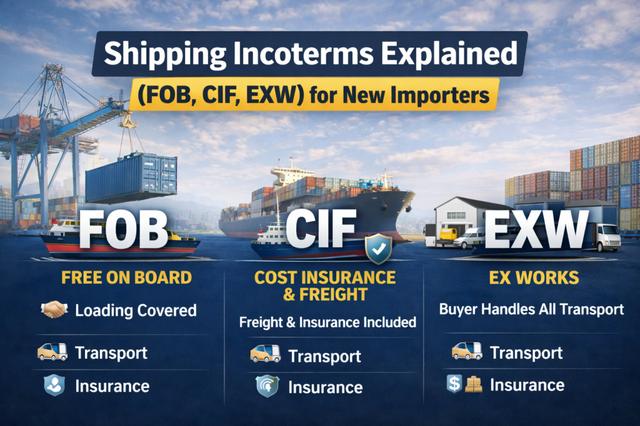
EXW (Ex Works): Seller makes goods available at their premises; buyer handles almost everything from there.
FOB (Free On Board): Seller delivers goods on board the vessel at the port of shipment; buyer takes over after loading.
CIF (Cost, Insurance & Freight): Seller pays ocean freight and insurance to the destination port, but buyer still takes risk after loading on the vessel.
FOB and CIF are for ocean (sea) freight and inland waterways.
If you’re shipping by air, courier, rail, or truck cross-border, terms like FCA/CIP/DAP/DDP are often more appropriate.
You can still learn FOB/CIF for sea imports (where they’re very common), but don’t force them onto air shipments.
Always write it like this:
Incoterm + named place/port + Incoterms® 2020
Examples:
EXW Shenzhen, Incoterms® 2020
FOB Shanghai, Incoterms® 2020
CIF Rotterdam, Incoterms® 2020
The “named place/port” matters because responsibilities and costs change depending on exactly where the handover happens.
| Task | EXW | FOB | CIF |
|---|---|---|---|
| Packaging for shipment | Seller | Seller | Seller |
| Load onto first truck at seller’s site | Buyer (often) | Seller (commonly handled) | Seller (commonly handled) |
| Inland trucking to port of export | Buyer | Seller | Seller |
| Export customs clearance | Buyer (common issue!) | Seller | Seller |
| Terminal handling at origin | Buyer | Seller (up to loading) | Seller (up to loading) |
| Load onto vessel | Buyer (via forwarder) | Seller | Seller |
| Ocean freight to destination port | Buyer | Buyer | Seller |
| Cargo insurance | Buyer | Buyer | Seller (minimum required level) |
| Import customs clearance | Buyer | Buyer | Buyer |
| Duties & taxes | Buyer | Buyer | Buyer |
| Delivery from destination port to final warehouse | Buyer | Buyer | Buyer |
EXW: risk transfers when goods are made available to the buyer (often at seller’s premises).
FOB: risk transfers once goods are loaded on board the vessel at the port of export.
CIF: risk transfers once goods are loaded on board the vessel too (same point as FOB), even though the seller pays freight and insurance to the destination port.
That last line surprises many first-time importers: CIF does not mean the seller carries the risk all the way to your destination.
Under EXW, the seller’s main obligation is to:
make the goods available at their facility (factory/warehouse), packaged as agreed.
From that moment onward, the buyer arranges pickup, export clearance, main transport, insurance, import clearance, and delivery.
EXW can make sense if:
you have a strong logistics team or freight forwarder in the seller’s country,
you want maximum control over the whole shipment,
you’re consolidating cargo from multiple suppliers and coordinating pickups.
In many real-world shipments, export customs clearance is easier (or sometimes only practical) when handled by the seller or by an agent acting on the seller’s behalf.
With EXW, the buyer is supposed to handle export formalities. That can create issues like:
the supplier refuses to act as exporter of record,
the forwarder can’t file export documents without the supplier’s cooperation,
delays at origin when documentation isn’t aligned.
If you want EXW-like control but fewer export headaches, many importers choose FCA (Free Carrier) instead of EXW (especially for container shipments). But if you’re sticking to EXW, confirm in writing:
who loads the truck,
who files export clearance,
who is listed as exporter on the export documents.
With FOB, the seller is responsible up to the point the goods are loaded on board the vessel at the port of shipment.
Typically, the seller covers:
transport from their facility to the port,
export clearance,
origin terminal processes leading up to loading.
The buyer typically covers:
ocean freight (booking the carrier via forwarder),
insurance (if desired),
destination charges, import clearance, duties/taxes, and final delivery.
FOB often hits the “sweet spot”:
The supplier handles export-side complexity in their home country (where they’re experienced)
You control the international freight cost and forwarder relationship
You can choose service level (fast/slow, direct/transshipment)
You might hear terms like “FOB destination” in domestic shipping conversations. In international Incoterms usage, FOB is tied to a named port of shipment and is for ocean transport. Make sure your paperwork matches standard Incoterms wording.
Ask your forwarder for:
all-in ocean rate plus
destination local charges estimate
so you can compare apples-to-apples with CIF offers.
With CIF, the seller pays for:
ocean freight to the destination port, and
cargo insurance (typically at minimum coverage).
But risk transfers when the goods are loaded onto the vessel at origin-same as FOB.
So CIF is best understood as:
“Seller pays to get it to the destination port, but the buyer still carries the shipping risk after loading.”
CIF is convenient because it looks simple: “freight included.” But it can hide cost surprises:
The seller chooses the carrier/service (you may get slow routes)
Destination charges can still be billed to you (and they vary a lot)
The included insurance may be minimal and may not cover your real exposure
The insurance under CIF is usually basic. If you’re shipping high-value, fragile, or theft-prone goods, you may want to buy your own cargo insurance (or ask for stronger coverage in the contract).
If you accept CIF, still ask for:
the freight forwarder/carrier name,
route and transit time,
destination charges list (what you’ll pay on arrival),
a copy of the insurance certificate and what it covers.
New importers often compare quotes like this:
Supplier A offers CIF
Supplier B offers FOB
…and CIF “looks cheaper.”
But CIF bundles costs into the product price, while FOB separates them. To compare fairly, calculate landed cost:
Landed Cost = product cost + origin charges + main freight + insurance + destination charges + duties/taxes + final delivery
FOB gives you more visibility/control on freight.
CIF gives you convenience but less transparency.
You care about cost per cubic meter.
You can tolerate slightly longer transit.
Often a good fit: FOB (you shop freight rates) or CIF (if your supplier’s freight deal is strong and destination charges are reasonable).
Insurance and damage risk matter.
You want reliable routing and tracking.
Often a good fit: FOB plus your own cargo insurance and a forwarder you trust.
You need pickups, coordination, and a warehouse/consolidation plan.
Often a good fit: EXW (or FCA) with your forwarder managing origin pickups and consolidation.
you have an experienced forwarder handling pickup and export processes,
you’re consolidating multiple suppliers,
you want maximum control (and you’re prepared for more coordination).
you want control over freight cost and carrier choice,
you want the supplier to handle export clearance and origin delivery,
you want the most common “balanced” option for ocean importing.
you want a simpler quote that includes ocean freight,
you’re okay with less control over routing,
you confirm destination charges and insurance details upfront.
Assuming CIF means “seller carries all risk to destination.”
Risk transfers at loading, not arrival.
Using FOB/CIF for air freight.
Use terms designed for multimodal shipping if you’re not shipping by sea.
Not specifying the named port/place.
“FOB China” is not precise enough. Always name the port.
Ignoring destination charges on CIF.
CIF includes freight to port, but destination handling and documentation fees can still be payable by the buyer.
Choosing EXW without confirming export clearance responsibility.
This causes real delays and last-minute “extra fees.”
The future of freight is becoming more predictive, connected, and digital. This blog explains how AI improves decision-making, IoT expands r...

Growing import businesses often lose time and money through manual freight coordination. This blog uses published SME examples to show how d...

Learn how online freight marketplaces help importers get instant container-shipping quotes, compare options quickly, and improve booking dec...