
Trade Guide
The Future of Freight: AI, IoT & Blockchain in International Shipping
The future of freight is becoming more predictive, connected, and digital. This blog explains how AI improves decision-making, IoT expands r...
Understand who pays customs duties, taxes, and shipping costs under FOB vs CIF. Learn how Incoterms impact import liability and landed cost.
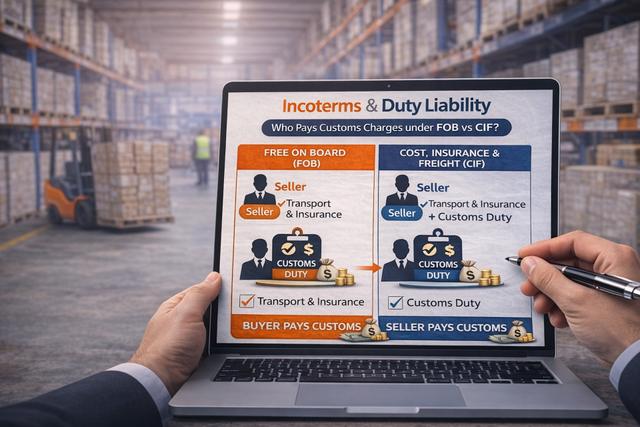
One of the most common import misunderstandings is thinking that the Incoterm decides who pays all customs charges. It does not. Incoterms mainly allocate logistics tasks, costs, and risk between seller and buyer. The U.S. International Trade Administration and ICC both describe Incoterms as rules that clarify who handles shipment, insurance, documentation, and customs formalities in the sale transaction, but they do not set the contract price, payment timing, or transfer of title.
For Indian importers, the practical answer is usually this: under both FOB and CIF, the buyer/importer normally pays the destination-side customs charges in India such as import duty, IGST, customs-clearance costs, and most post-arrival local charges. The main difference between FOB and CIF is not import-duty liability. It is who pays for the main ocean freight and cargo insurance before the goods reach the destination port.
There is also one important scope point. Both FOB and CIF are Incoterms reserved for sea and inland waterway transport, and several trade guides caution that they are often misused for containerized cargo where FCA or CIP may be more appropriate.
A lot of buyers choose CIF because it looks simpler and FOB because it looks cheaper. But the wrong comparison creates confusion at the destination port. Under both terms, import formalities at destination still sit with the buyer. ICC Academy’s guidance on the “C” rules is explicit that all “C” terms, including CIF, require the buyer to complete import formalities. Its FOB guidance says the buyer also handles import customs formalities under FOB.
So the better question is not, “Does CIF mean the seller pays Indian customs duty?” The better question is, “How are freight, insurance, export clearance, import clearance, and local destination charges split between the two parties?” That is where FOB and CIF differ commercially.
Under FOB (Free on Board), the seller is responsible for getting the goods to the port of shipment, clearing them for export, and loading them on board the vessel. Once the goods are on board, risk transfers to the buyer, and the buyer becomes responsible for the main carriage and the costs after that point. Maersk’s FOB guide and ICC Academy’s FOB analysis both describe this split clearly.
That means, in normal India import practice, the seller pays origin-side export costs, while the buyer pays ocean freight, insurance if separately arranged, Indian import clearance, Indian customs duty/IGST, and post-arrival movement. ICC Academy also notes that the buyer must handle import formalities under FOB.
From a control perspective, FOB often gives the importer more say over carrier choice, sailing schedule, and freight pricing. Cogoport’s FOB importer guide argues that this can improve transparency because the buyer is not dependent on the supplier’s chosen shipping line and can compare rates directly.
Under CIF (Cost, Insurance and Freight), the seller arranges and pays for the ocean freight to the named destination port and also provides insurance cover for the voyage. But that does not mean the seller keeps risk all the way to India. ICC and Maersk both explain that under CIF, risk still transfers to the buyer once the goods are loaded on board the vessel at origin.
This is the point that confuses many importers. Even though the seller pays freight and insurance under CIF, the buyer still handles import formalities and destination customs. ICC Academy’s “C” rules guide states that all “C” terms require the buyer to complete import formalities, and Cogoport’s China–India Incoterms guide says that after arrival at the destination port, the buyer is responsible for import clearance, local port charges, and onward delivery.
So, for Indian imports, CIF does not usually shift customs duty liability to the seller. It mainly shifts the prepaid freight-and-insurance leg to the seller while leaving import clearance and Indian taxes with the buyer.
For most standard sea imports, the practical split looks like this:
Under FOB:
Seller handles origin transport to port, export clearance, and loading on board.
Buyer handles ocean freight, insurance if desired, destination port charges, import customs formalities, duties/taxes, and inland delivery.
Under CIF:
Seller handles origin transport, export clearance, freight to the named destination port, and minimum insurance.
Buyer still handles import customs formalities, import duties/taxes, many destination charges, and inland delivery after arrival.
There is one nuance worth noting. ICC Academy says that under the “C” terms, unloading charges at destination are the seller’s responsibility only if the carriage contract puts those costs on the seller. Otherwise, they remain the buyer’s responsibility. So even under CIF, some local destination costs can still sit with the buyer depending on the transport contract.
In India, the customs process still sits with the importer side. Chennai Customs’ import procedure states that every importer files a Bill of Entry for home consumption or warehousing, must support it with documents such as invoice, packing list, bill of lading, licence where necessary, insurance document where relevant, and certificate of origin if claiming preference, and must certify the correctness of the declaration. The same procedure says duty is assessed, the importer’s representative deposits the duty, and then the goods can be taken delivery of from the custodian.
CBIC’s Electronic Cash Ledger circular also reinforces the same commercial reality by describing the importer, exporter, or any person liable to pay duty, integrated tax, cess, fees, or other amounts under customs as the party using the payment mechanism. In ordinary commercial imports, that liability usually sits with the importer side, not with the foreign seller under FOB or CIF.
So if you are importing into India under either FOB or CIF, you should usually plan for the Indian buyer to handle:
customs broker or filing costs,
import duty and IGST,
customs examinations or related clearance costs where applicable,
and release/delivery coordination after arrival.
If the commercial intent is for the seller to bear destination-country import charges, you are usually talking about DDP, not FOB or CIF. ICC Academy’s DAP vs DDP guidance says DDP requires the seller to handle and pay export, transit, and importantly import clearance formalities, including associated tariffs and taxes. It also notes that in some countries local legal restrictions can make DDP difficult because import authorities may require the local importer to handle clearance.
That is helpful because it clears up a common misconception: CIF is not “almost DDP.” CIF still leaves import clearance with the buyer. DDP is the term that moves import-duty responsibility toward the seller, at least contractually.
This depends on what you want to optimize.
FOB is often better when you want:
more control over freight negotiation,
more visibility into carrier and schedule choices,
cleaner comparison-shopping across forwarders or carriers,
and tighter control over total landed cost.
CIF can be useful when you want:
a simpler supplier-managed origin and ocean leg,
less involvement in export-side handling,
and a single commercial number covering goods plus freight and insurance to port.
But CIF often gives the importer less transparency over the freight leg. Cogoport’s China–India and FOB importer guides both suggest buyers should be careful here because the supplier controls the freight booking, while the buyer still carries destination-side customs and local cost exposure.
Before you approve the shipment terms, check these points:
Confirm whether you want control over freight buying or simplicity of supplier-managed freight. FOB usually favors control; CIF favors simplicity.
Do not assume CIF means the seller pays Indian customs duty. Under normal CIF use, the buyer still handles import formalities and destination customs charges.
Budget separately for destination charges such as customs-clearance costs, documentation, inspections, duties, taxes, and admin charges.
Make sure your internal team knows that Incoterms do not determine title transfer or payment timing.
For standard container shipping, ask whether FCA or CIP would be more appropriate than FOB or CIF.
Assuming CIF means “seller pays everything to India.”
CIF covers freight and insurance to the named port, but import formalities and destination customs usually still stay with the buyer.
Assuming FOB changes who pays Indian import duty.
FOB changes the split of freight and risk, not the normal importer-side liability for Indian customs clearance and taxes.
Treating Incoterms as tax law.
Incoterms allocate commercial responsibilities between buyer and seller, but they do not replace destination-country customs rules.
Using FOB or CIF casually for containerized cargo.
Multiple trade guides warn that these are sea-only rules and are often misapplied to container shipments.
This is where a platform view matters. Cogoport’s China–India Incoterms guide lays out the practical split between EXW, FOB, and CIF from an Indian importer’s perspective, including who handles freight, insurance, import clearance, and local port charges. Its FOB importer guide also argues that FOB can improve cost control by letting buyers compare schedules and shipping-line rates directly.
That matters because the real decision is rarely just “FOB or CIF?” The real decision is whether you want the supplier to prepay the freight leg or whether you want your own team to control freight procurement while still handling import clearance in India. Cogoport fits naturally into that workflow because it helps importers compare options, gain rate visibility, and align shipping choices with the commercial term they negotiate.
Under both FOB and CIF, the foreign seller usually handles export clearance. Under both terms, the Indian buyer/importer usually handles import customs formalities, import duty, IGST, and most destination-side customs charges. The real commercial difference is that under FOB, the buyer books and pays the main ocean freight and insurance, while under CIF, the seller books and pays those up to the named destination port.
So if you are asking, “Who pays customs charges under FOB vs CIF?” the answer for most India imports is: the buyer pays destination customs charges under both. If you want the seller to shoulder import-duty responsibility too, you are usually moving out of FOB/CIF territory and into DDP-type thinking.
ICC, “Incoterms® 2020.” Used for the overall purpose of Incoterms, cost articles, insurance note on CIF, and import/export-clearance structure within the rules.
U.S. International Trade Administration, “Know Your Incoterms.” Used for what Incoterms cover, what they do not cover, and the point that they do not determine title or payment terms.
Maersk, “Free on Board (FOB) Incoterms® explained.” Used for FOB responsibilities, export-clearance obligations, buyer cost shift after loading, and the caution on containerized cargo.
Maersk, “Cost, Insurance, and Freight (CIF) Incoterms® explained.” Used for CIF responsibilities, seller-paid freight and insurance, risk transfer on board, destination-side buyer costs, and the caution on containerized cargo.
ICC Academy, “Incoterms® 2020: A practical guide to ‘C’ and ‘D’ rules.” Used for the rule that all “C” terms require the buyer to complete import formalities, seller-paid freight/insurance under CIF, and unloading-cost nuance depending on the carriage contract.
ICC Academy, “Incoterms® 2020: FAS or FOB?” Used for FOB buyer obligations on freight and import formalities, seller export formalities, and sea-only scope.
ICC Academy, “Incoterms® 2020: DAP or DDP?” Used for the contrast showing that DDP, not CIF, is the rule where the seller handles import clearance and associated import costs.
Chennai Customs Zone, “Import Procedure.” Used for the India import-side process: Bill of Entry filing, document set, importer declaration, assessment, duty payment, and delivery.
CBIC, Circular No. 09/2023-Customs on Electronic Cash Ledger. Used for the importer/person-liable-to-pay-duty, integrated tax, cess, fees, and payment-process framing.
Maersk, “Beyond the border: Understanding customs clearance charges.” Used for the definition of customs-clearance charges as documentation, inspection, duties, taxes, and administrative costs.
Cogoport, “Best Incoterm for China–India Trade: FOB vs CIF vs EXW.” Used for the India-importer view that under CIF the buyer still handles import clearance, local port charges, and onward delivery, and for the practical comparison of FOB and CIF.
Cogoport, “Free on Board (FOB) with Cogoport for Importer.” Used for the importer-control and freight-transparency perspective under FOB versus CIF.
Cogoport, “Incidental Shipping Fees and Customs Costs.” Used for the practical breakdown of local charges, customs-clearance fees, and destination-side shipping costs importers should still budget for.
The future of freight is becoming more predictive, connected, and digital. This blog explains how AI improves decision-making, IoT expands r...

Growing import businesses often lose time and money through manual freight coordination. This blog uses published SME examples to show how d...

Learn how online freight marketplaces help importers get instant container-shipping quotes, compare options quickly, and improve booking dec...