
Trade Guide
The Future of Freight: AI, IoT & Blockchain in International Shipping
The future of freight is becoming more predictive, connected, and digital. This blog explains how AI improves decision-making, IoT expands r...
A practical guide to choosing between 20ft and 40ft containers based on weight vs volume, pallet fit, cost efficiency, delivery access, and cargo safety-plus when a 40ft High Cube is the better option.
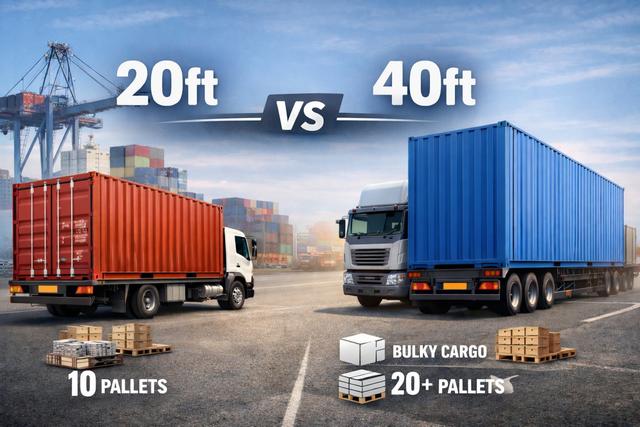
Choosing between a 20-foot and a 40-foot container seems simple-until it affects your freight cost, cargo safety, packing efficiency, and even whether your shipment can legally move inland by truck. The “right” size depends less on what you’re shipping and more on how your cargo behaves: Is it weight-dense or volume-dense? Standardized or irregular? One SKU or many?
This guide breaks down the differences and gives you a practical decision framework you can use before you book.
20ft container (20’ standard dry): Best for heavy, dense cargo that hits weight limits before filling the space.
40ft container (40’ standard dry): Best for bulky or higher-quantity cargo where volume matters most.
40ft High Cube (40’ HC): Same footprint as 40’, but taller-ideal for extra-volume shipments (furniture, cartons, lightweight goods).
Note: Dimensions and weight ratings vary slightly by manufacturer and shipping line. Always confirm the exact limits from the container’s CSC plate and your carrier/forwarder.
| Spec (Typical) | 20ft Standard Dry | 40ft Standard Dry |
|---|---|---|
| Internal length | ~5.9 m | ~12.0 m |
| Internal width | ~2.35 m | ~2.35 m |
| Internal height | ~2.39 m | ~2.39 m |
| Approx. volume | ~33 m³ | ~67 m³ |
| Typical max gross | ~30,480 kg | ~30,480 kg |
| Typical tare weight | ~2,200–2,400 kg | ~3,700–4,000 kg |
| Typical max payload | ~28,000 kg | ~26,000–27,000 kg |
Key insight: A 40ft container has about double the volume of a 20ft, but usually a slightly lower payload because the container itself is heavier.
Your cargo is heavy for its size. Many shipments reach weight limits long before the container is full, such as:
Metal products (coils, bars, parts)
Stone, tiles, ceramics
Machinery and equipment
Paper rolls
Chemicals (depending on packaging and regulations)
Why 20ft helps:
A smaller container makes it easier to stay compliant with road axle limits and reduces the risk of overweight charges inland.
Your cargo is lightweight but bulky, so you fill space before hitting weight limits:
Apparel, textiles, shoes
Furniture (especially knock-down/flat-pack)
Consumer goods in cartons
Plastics and packaging materials
E-commerce parcels and mixed cartons
Why 40ft helps:
You can load more units per container, often improving cost per unit shipped.
Pallet fit depends on pallet size, loading method, and whether you double-stack (if allowed). As a practical rule of thumb:
20ft: ~10 standard US pallets (48"×40") or ~11 Euro pallets (1200×800 mm)
40ft: ~20-21 standard US pallets or ~24-25 Euro pallets
If your shipment is palletized and consistent, this quick check often makes the decision obvious.
Not always-but it’s often better value per cubic meter.
A 40ft container often costs less than two 20ft containers on the same route.
Your per-unit or per-carton shipping cost may drop when moving from 20ft to 40ft.
You’re weight-limited anyway (a 40ft won’t let you ship more weight)
Destination trucking has strict axle/weight limits or high overweight penalties
You need to split delivery to multiple sites and avoid cross-docking
20ft equipment is more available on your lane (availability varies by region and season)
Even if ocean freight looks great on a 40ft, the container still needs to be delivered, unloaded, and returned.
The delivery site has tight turns, narrow lanes, or limited yard space
You unload with smaller forklifts and limited dock space
Your cargo is heavy and you want better weight distribution
You have a spacious unloading area and a clear turning radius
You want to unload more product in one go
Your facility is optimized for high-throughput receiving
If you’re delivering to dense urban areas, older industrial zones, or small warehouses, 20ft can reduce delivery headaches.
Container size changes how your cargo behaves in transit.
Heavy loads tend to “sit” better in a 20ft because you’re less likely to end up with uneven weight distribution across a long floor span.
In a 40ft, it’s easier to create:
Longitudinal gaps (cargo shifting risk)
Uneven loading (poor weight balance)
Stacking pressure (cartons crushed if not planned)
If your cargo is mixed SKUs with varied carton strength, plan bracing, dunnage, and stacking carefully-especially for 40ft.
If your cargo is very volume-heavy (but not too heavy), a 40ft High Cube (HC) is often the sweet spot:
Same length and width as a 40ft standard
Extra height (commonly about 1 foot / ~30 cm more internal height)
Useful for tall pallets, lightweight cartons, furniture, and retail goods
Choose 40’ HC when: you’re frequently “running out of space” in 40ft standard but still nowhere near weight limits.
My cargo is heavy/dense (likely to hit weight limits)
Overweight inland trucking is a risk
Delivery site access is tight
I prefer easier weight distribution and simpler loading
I don’t need maximum volume
My cargo is bulky/light (likely to cube out)
I want lowest cost per unit/carton
I need to ship larger quantities in one booking
I have a good unloading setup and enough yard space
I’m loading lots of palletized cartons or mixed SKUs
I need extra vertical space (tall cartons/pallets)
My goods are lightweight and I want max volume per container
High weight per carton
Likely to hit payload limits quickly
Better choice: 20ft
You’ll usually max out weight before you run out of space-so a 40ft won’t carry “double” the tiles.
Light cartons, high count
Space is the constraint
Better choice: 40ft (or 40ft HC if cartons are tall)
You’ll typically improve cost per piece because you can load many more cartons.
Multiple SKUs with different delivery points
Better choice: Depends on distribution plan
If you need to split deliveries, two 20ft might reduce repacking/cross-docking
If you deliver to one DC, one 40ft may be simpler and cheaper per unit
The future of freight is becoming more predictive, connected, and digital. This blog explains how AI improves decision-making, IoT expands r...

Growing import businesses often lose time and money through manual freight coordination. This blog uses published SME examples to show how d...

Learn how online freight marketplaces help importers get instant container-shipping quotes, compare options quickly, and improve booking dec...