
Trade Guide
The Future of Freight: AI, IoT & Blockchain in International Shipping
The future of freight is becoming more predictive, connected, and digital. This blog explains how AI improves decision-making, IoT expands r...
Learn how to file an import declaration (Bill of Entry) in India step-by-step using ICEGATE. Avoid delays with proper documentation and compliance.
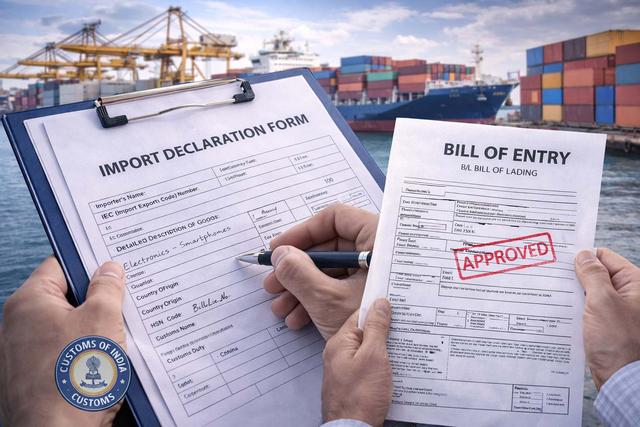
In India, filing an import declaration usually means filing the Bill of Entry (BoE). It is the core customs declaration used to report the shipment, and Cogoport’s India import guides describe it as the document that carries the importer’s IEC and GST details, supplier and invoice data, HS codes, quantity, value, country of origin, and duty assessment. In other words, this is the form that turns cargo into a customs case.
What many importers call “paperwork” is actually a digital process. ICEGATE registration is a prerequisite for filing customs documents online, and ICEGATE offers multiple electronic filing channels, including RES package, service centre, SMTP/e-mail, third-party applications, webform, and web upload. For many importers, the smartest way to think about the process is not as one document, but as a sequence: registration, data preparation, BoE filing, acknowledgements, duty payment, and release.
A Bill of Entry becomes slower and more expensive when the basic identifiers are not aligned. ICEGATE’s registration guidance says importers/exporters are asked for a valid IEC, and GSTIN must be entered and verified during registration-related flows. CBIC’s GST guidance separately says that to avail input tax credit of import IGST and compensation cess, the importer must mandatorily declare the GSTIN in the Bill of Entry, while ICEGATE’s integrated-declaration FAQ makes clear that the AD Code of the branch responsible for outward remittance is mandatory in the BE declaration.
That means the import declaration process really starts before the ship sails. If IEC, GSTIN, and AD Code are not ready, the BoE is not truly ready either. And if your cargo is moving under a concession or regulator-controlled route, those extra declarations need to be built into the same filing plan, not handled as an afterthought.
The first step is straightforward: make sure the importing entity is ready to file. ICEGATE registration is required for customs document filing, and the registration flow for importer/exporter users asks for GSTIN verification and a valid IEC. This is the practical starting point whether you file directly or through a customs broker.
If you want IGST credit to flow correctly later, make sure the GSTIN you intend to use is the one that gets declared properly in the BoE. If your remittance branch details are wrong, the AD Code issue can create avoidable friction in filing. Small mismatches at this stage often become expensive “document problems” later, even though the shipment itself is fine.
Before the importer files the BoE, the carrier-side data needs to exist. Cogoport’s IGM guide explains that the shipping line or its agent files the Import General Manifest (IGM) before vessel arrival, and the importer or broker then files the Bill of Entry referencing that manifest data. Its guide also notes that mismatches between manifest data and importer documents can trigger delay.
At the same time, the importer should already have the commercial file ready. Cogoport’s customs-duty guide says the common document stack includes the commercial invoice, packing list, bill of lading, IEC, insurance certificate where relevant, and the Bill of Entry itself. The same source says these documents are uploaded through e-Sanchit/ICEGATE and then assessed electronically.
This is also the stage where prior filing helps. Cogoport’s Vietnam-to-India FCL guide says Indian importers can prepare and submit the import customs declaration before vessel arrival, and recommends sending the document pack to the customs broker while the goods are still in transit. That is the cleaner workflow for most commercial shipments.
ICEGATE supports more than one way to file. Its public site map lists filing through RES package, service centre, SMTP/e-mail, third-party applications, webform, and web upload, and the webforms manual specifically says ICEGATE provides the webforms facility for preparing the Bill of Entry.
For many SMEs or occasional importers, the webform route is the easiest to understand conceptually because it behaves like a guided digital form. ICEGATE’s Bill of Entry webform guidance says the user needs to provide details such as IEC code, importer name and address, Custom House code, BE type, and customs broker code. That is a useful reminder that the BoE is not just a product sheet; it is a structured declaration tied to the importer, location, and filing mode.
This is the heart of the process. Cogoport’s filing guides say the BoE captures the importer’s IEC and GST number, supplier details, invoice details, HS codes, quantities, values, origin country, and duty assessment. ICEGATE’s BE message-format guidance similarly describes the Bill of Entry as the import declaration and explains the message structures used for that filing.
The practical lesson is simple: this is where classification, valuation, and tax logic meet. If you are claiming IGST credit, GSTIN must be correct. If your bank branch details are wrong, AD Code becomes a filing issue. If the invoice values or HS codes do not match the rest of the document set, customs queries become more likely. The cheapest BoE is usually the one you do not have to correct later.
Not every import is a plain-vanilla BoE. If you are importing under the Import of Goods at Concessional Rate of Duty (IGCR) route, ICEGATE’s IGCR guidance says you first generate an IIN on the IGCR dashboard, and that IIN has to be quoted in the Bill of Entry for availing the concessional-duty benefit. That means concessional import declarations start before the BoE itself.
Likewise, if your goods require partner-government-agency clearance, the BoE filing can become the entry point for those approvals. ICEGATE’s AQCS and PQMS advisories say that after filing the integrated Bill of Entry declaration, trade users can get their AQCS or PQMS NOC issued through the unified dashboard. So the BoE is not always the end of the clearance journey; sometimes it is the trigger for the next regulatory step.
Once filed, the BoE should not be treated like a black box. ICEGATE’s message-format guidance lays out the standard sequence: Bill of Entry submission, positive or negative acknowledgement, processed BE, query, query reply, and out-of-charge message. That is useful because it tells importers what “progress” actually looks like in system terms.
ICEGATE also provides post-login enquiry tools to track what is happening. Its enquiries module says IEC and CHA users can use Bill of Entry job-status enquiries, while the same module also supports BE acknowledgement status and Release Order Status lookups using the BoE number, date, location, and agency fields. This is the part of the process many teams underuse. They file the declaration, then wait passively instead of watching the status flow.
If something changes or was filed incorrectly, do not assume the only option is manual chasing. ICEGATE has a dedicated Bill of Entry Amendment webform, and its reassessment manual says importers/IEC holders can raise reassessment requests online and view their status on ICEGATE 2.0. The reassessment process can result in either reduced duty or enhanced duty, and in the latter case a challan can be generated for payment.
That matters because import declarations are not always perfect at first filing. The smart workflow is not “never make a mistake.” It is “use the formal digital path to fix the mistake quickly.”
Once assessment is complete, the financial side kicks in. ICEGATE’s Customs ePayment Platform 2.0 is described as a comprehensive solution for managing challan payments related to customs duties and related transactions. Cogoport’s customs-duty guide adds the practical milestone: once the documents are verified and the applicable duties are paid online, the importer receives a digital Out of Charge (OOC) message allowing cargo release.
ICEGATE’s e-filing-message framework also shows how the system talks to custodians after filing and release. The message list includes Bill of Entry information on submission, Bill of Entry on Out of Charge, and Import Consignment Exit (Gate Pass). That is a good reminder that filing the BoE is not the end goal; physical cargo movement follows the system events that come after it.
Before the next shipment arrives, check these basics:
Confirm that the importer profile is ready on ICEGATE, with the right IEC, GSTIN, and remittance AD Code logic.
Make sure the carrier-side IGM data and your invoice / packing / bill-of-lading data match before the BoE is prepared.
File early when possible instead of waiting until berthing day.
Use the right ICEGATE filing channel for your business: webform, RES, third-party app, service centre, SMTP/e-mail, or web upload.
If you are using IGCR or a regulator-linked import route, add those declarations before the BoE goes in.
Track acknowledgement, query, and release status instead of assuming silence means progress.
Treating the Bill of Entry like a final-stage document
It is actually a pre-arrival planning document for most well-run imports, not something to begin only when the ship is already at port.
Filing without aligning GSTIN and AD Code
That weakens both tax-credit handling and remittance-data accuracy inside the declaration.
Ignoring the status tools after filing
ICEGATE already gives importers and brokers enquiry tools for BoE status, acknowledgement status, release-order status, and job status. Not using them is an avoidable blind spot.
Waiting too long to correct a wrong declaration
If the filing is wrong, use amendment or reassessment workflows early instead of letting the problem sit until cargo release is blocked.
Cogoport’s India import-content library is built around this exact workflow: document preparation, customs filing, duty understanding, and post-filing execution. Its import-documents guide explains the customs-document stack and risks, while its customs-duty guide walks through assessment, duty payment, and the OOC stage.
Its digital-booking guidance also says Cogoport integrates with ICEGATE for electronic filing of Bills of Entry and Shipping Bills, while supporting digital payments for freight and related transaction steps. For importers who want the declaration process tied more closely to freight execution, that kind of workflow reduces handoffs.
Filing an import declaration in India is not a single click. It is a sequence: get the importer profile ready, line up shipment data, choose the filing route, fill the Bill of Entry carefully, add any concession or regulator declarations, track acknowledgements, pay duty, and move toward out-of-charge and gate-out. When that sequence is respected, the BoE becomes a control point instead of a delay point.
For Cogoport’s audience, the practical lesson is simple: file earlier, file cleaner, and track more actively. Import declarations become smoother when documentation, customs data, payment, and cargo release are handled as one connected process.
ICEGATE, Registration FAQ. Used for the point that ICEGATE registration is a prerequisite for filing customs documents.
ICEGATE, Registration on ICEGATE 2.0 / Registration Manual. Used for GSTIN verification and valid IEC requirement during importer/exporter registration.
CBIC, Guidance Note for Importers and Exporters. Used for mandatory GSTIN declaration in Bill of Entry to avail import IGST/compensation-cess credit.
ICEGATE, SW Declaration FAQ 1.1. Used for mandatory AD Code declaration in the Bill of Entry.
ICEGATE, Web Forms Manual. Used for the availability of Bill of Entry webforms and core BE input fields.
ICEGATE, Main Website / Site Map / Electronic Filing options. Used for the list of available filing channels such as RES, service centre, SMTP/e-mail, third-party applications, webform, and web upload.
ICEGATE, Bill of Entry Message Format / ICES Imports Message Exchange Document. Used for the definition of the BE as import declaration and the filing/ack/query/processed/OOC message flow.
ICEGATE, e-Filing Messages. Used for custodian-side messages on BoE submission, out-of-charge, and gate pass / exit flow.
ICEGATE, Enquiries Module / BoE Status Advisories. Used for BE job status, BE acknowledgement status, and release-order status tracking.
ICEGATE, Bill of Entry Amendment Webform and Re-assessment Process User Manual. Used for digital correction and reassessment workflow after filing.
ICEGATE, Customs ePayment Platform 2.0. Used for challan-payment workflow for customs duties.
ICEGATE, IGCR FAQs / IGCR Manual. Used for the requirement to generate an IIN and quote it in the BoE for concessional-duty claims under IGCR.
ICEGATE, AQCS / PQMS integrated BoE advisories. Used for the point that NOCs for those agencies can move through the unified dashboard after filing the integrated Bill of Entry declaration.
Cogoport, Import General Manifest (IGM): Process, Documentation & Compliance. Used for the carrier-first / importer-next flow where the BoE is filed against manifest data.
Cogoport, Import Documents & Customs Clearance in India and Customs Duty and GST on Imports by Sea to India. Used for the India import-document stack, e-Sanchit upload flow, assessment, duty payment, and digital OOC explanation.
Cogoport, Importing from Vietnam to India: Step-by-Step FCL Shipping Guide. Used for the practical explanation of prior BoE filing while cargo is still in transit and the typical data included in the declaration.
Cogoport, Book Ocean Freight Online in India (2025 Guide). Used for Cogoport’s ICEGATE integration and digital customs/payment workflow positioning.
The future of freight is becoming more predictive, connected, and digital. This blog explains how AI improves decision-making, IoT expands r...

Growing import businesses often lose time and money through manual freight coordination. This blog uses published SME examples to show how d...

Learn how online freight marketplaces help importers get instant container-shipping quotes, compare options quickly, and improve booking dec...