
Trade Guide
The Future of Freight: AI, IoT & Blockchain in International Shipping
The future of freight is becoming more predictive, connected, and digital. This blog explains how AI improves decision-making, IoT expands r...
Learn how the China+1 strategy helps importers diversify suppliers, reduce risk, and build resilient supply chains without increasing costs significantly.
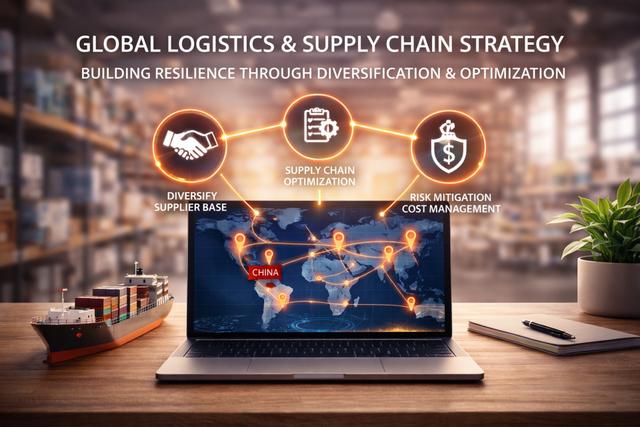
For Indian importers, China+1 is no longer a boardroom buzzword. It is a practical sourcing decision about how much of your supply base can stay concentrated in one country before a price shock, policy change, component shortage, or freight disruption turns into a margin problem. Official trade data shows India imported ₹9,59,665.71 crore worth of goods from China in FY2024-25, equal to 15.74% of India’s total imports. In several categories, dependence was much higher: electronics components at 37.94%, telecom instruments at 43.41%, computer hardware and peripherals at 49.46%, industrial machinery at 45.30%, and bulk drugs and drug intermediates at 74.11%.
The Government has also been explicit about what sits inside that dependence. In March 2026, it said imports from China remain high largely because India needs capital goods, intermediate goods, and raw materials such as APIs, auto components, electronic parts and assemblies, and mobile phone parts for fast-expanding sectors like electronics, pharma, telecom, and power. That is why the real sourcing question is rarely, “Can I stop buying from China?” It is more often, “Which inputs need a second source before one disruption becomes commercially painful?”
A stable China supplier does not eliminate concentration risk. Recent IMF work says diversifying sources of imports can mitigate adverse trade shocks by reducing reliance on single or concentrated suppliers, although it also comes with efficiency costs. WTO analysis in 2025 describes the current phase of globalization as one where supply chains are becoming shorter, more digital, and more regionally diversified, with reliability becoming a central competitive advantage.
There is one important strategic nuance here: China+1 does not usually mean a clean exit from China. A recent NITI Aayog paper says it is difficult to leave China completely in the short term because firms have spent decades building manufacturing ecosystems there, and in many cases final assembly may move while raw materials and components still continue to come from Chinese suppliers. OECD makes a similar point for Southeast Asia, noting that even when production shifts, China can remain dominant in the components feeding those factories.
The first mistake importers make is trying to diversify everything at once.
That usually adds cost and complexity faster than it adds resilience. IMF research suggests diversification is most useful when it is targeted at imports that are more exposed to shocks, more upstream in the supply chain, and harder to replace quickly. For Indian importers, that logic points first toward categories where dependence on China is already materially high, such as electronics components, telecom instruments, computer hardware, machinery, and bulk drugs or intermediates.
A better first step is to identify which China-origin inputs are critical to production continuity, customer commitments, or launch timelines. Those are your China+1 candidates. Routine or low-impact items can wait.
The second mistake is assuming “Vietnam” or “Thailand” is itself a diversification plan.
In practice, sourcing resilience improves when you understand which country is strong in which layer of the value chain. OECD’s 2025 Southeast Asia note says the region is deeply integrated into global supply chains, with over 60% of exports linked to them, and highlights country-specific strengths such as Malaysia in semiconductors, Viet Nam and Cambodia in electronics, Indonesia in EV-related supply chains, and Thailand in automotive products. It also notes that ASEAN received a record USD 229 billion in FDI in 2023, showing why it has become a serious diversification destination.
For importers, that means China+1 should usually be category-specific. Electronics sub-assemblies, packaging, mechanical parts, chemicals, and finished-goods assembly do not all need the same backup geography.
The third mistake is choosing the alternate supplier only on ex-factory price.
IMF’s 2025 working paper is clear that diversification involves a resilience-efficiency trade-off: you often pay something for redundancy, but you reduce exposure to major shocks. WTO’s 2025 GVC report adds that reliability now matters as much as simple cost minimization. So when you compare China against a +1 source, the right model is not unit price alone. It is total landed cost plus lead-time variability, payment terms, tooling cost, quality-risk cost, customs predictability, and the commercial cost of a stockout.
A supplier that is marginally more expensive on paper can still be the cheaper strategic option if it reduces disruption risk on a revenue-critical SKU.
The fourth mistake is approving an alternate supplier without making the product operationally substitutable.
IMF analysis highlights that resilience improves not only from diversification, but also from substitutability, meaning the ability to switch between inputs and suppliers without major operational loss. In importer terms, that means drawings, BOMs, tolerances, certification files, packaging specs, and QC checkpoints have to be standardized enough that a second source is genuinely usable when required. Otherwise, you may have a “backup supplier” on paper but not a real fallback in execution.
This is especially important in electronics, machinery parts, auto components, chemicals, and regulated pharma-linked inputs, where qualification failure can erase the value of having a second vendor.
The fifth mistake is thinking only about suppliers and not about corridors.
The Government said in March 2026 that it encourages Indian business establishments to explore alternative suppliers and diversify their supply chains, and that trade agreements with key partners are expected to diversify import sources. The Department of Commerce’s trade-agreements page shows India’s network now includes India-ASEAN arrangements, Singapore, Malaysia, Japan, Korea, UAE, Australia, EFTA, and the UK, among others. Depending on product coverage and origin conditions, that can create alternative sourcing paths that deserve landed-cost review before procurement teams default back to a China-only model.
In other words, China+1 is not only a factory question. It is also a duty, compliance, and corridor question.
The most exposed importers are usually the ones where one delayed or unavailable input can interrupt output, revenue, or customer commitments very quickly. Based on India’s current category dependence, that usually includes electronics and component buyers, telecom and networking importers, computer hardware distributors, industrial machinery importers, pharma and chemical businesses dependent on intermediates, and manufacturers that rely on China-origin auto components or assemblies. These are also the businesses most likely to feel the pain of single-vendor approval, long tooling cycles, or low inventory buffers.
If your demand model depends on continuity rather than just low purchase price, resilience should already be part of sourcing policy.
Use this before your next sourcing review:
Map your top China-origin SKUs by revenue impact, production impact, and stockout cost.
Separate them into three groups: stay China-only for now, pilot a +1 source, and diversify immediately.
Search for alternates by product cluster, not by country fashion.
Compare landed cost using price, duty, lead time, freight, MOQ, tooling, and working-capital impact.
Standardize drawings, testing, tolerances, and packaging so alternate suppliers are genuinely interchangeable.
Start with a pilot allocation rather than an abrupt full-volume shift.
Negotiate backup capacity, not just sample approval.
Review whether a different sourcing corridor changes customs or documentation complexity.
Keep your China supplier active while the second source proves reliability.
Align procurement, logistics, finance, and quality teams before committing to split sourcing.
These are the common importer mistakes in a China+1 transition:
treating China+1 as an overnight China-exit plan
adding one new country but creating a fresh single-country dependency
choosing alternates only on FOB price
approving backup suppliers without spec harmonization
ignoring duty, origin, and compliance implications
shifting volumes before the alternate supplier proves repeatability
assuming final-assembly diversification automatically solves upstream component dependence
The evidence is consistent: diversification helps, but it only works when it is targeted, operationally usable, and commercially modeled correctly.
This is the kind of market where execution discipline matters as much as sourcing strategy.
Cogoport’s platform is built around instant freight quotes, end-to-end logistics options across FCL, LCL, air, and customs clearance, shipment tracking and visibility, Cogo Assured for logistics reliability, and Pay Later for flexible payment options. That matters when procurement teams are comparing alternate source countries and need faster freight validation, better routing visibility, and tighter control over how sourcing changes affect cash flow and delivery confidence.
For importers trying to operationalize China+1, that usually means a few practical advantages:
faster freight comparison before finalizing a supplier shift
better visibility across different origin corridors
earlier coordination between freight, customs, and inland movement
live tracking when a new supply route is still being tested
financing flexibility when duplicate tooling, trial orders, or higher buffer stock begin affecting working capital
China+1 is not about abandoning China. It is about deciding where concentration is too risky and where redundancy is worth paying for.
For Indian importers, the starting point is clear: China remains a major source of supply overall and an especially concentrated one in several critical categories. Current IMF, OECD, WTO, NITI Aayog, and Government of India evidence all point in the same direction. Diversification can improve resilience, but it works best when it is targeted, category-specific, operationally substitutable, and backed by reliable trade corridors. The importers who treat China+1 as a structured sourcing and logistics program, not as a headline reaction, will usually protect continuity, margins, and bargaining power more effectively.
Government of India, Rajya Sabha, “Imports from China,” answered 05 Dec 2025. Used for India’s FY2024-25 import value, China’s share in total imports, and high-dependency product-category data.
Government of India, Rajya Sabha, “Rising imports from China and strategic trade imbalance,” answered 13 Mar 2026. Used for the Government’s description of why imports from China remain high, sector examples, and the policy position encouraging alternative suppliers and diversified supply chains.
International Monetary Fund, “Supply Chain Diversification and Resilience,” Working Paper WP/25/102, May 2025. Used for the resilience-efficiency trade-off and the case for targeted diversification of shock-exposed imports.
OECD, “Supply Chains in Southeast Asia: Connectivity and Resilience,” 2025 background note. Used for ASEAN’s role in global supply chains, FDI inflows, country-specific manufacturing strengths, and the caution that ecosystems outside China still take time to build.
WTO, “Resilience and Reglobalization: Global Value Chain Trends and New Opportunities,” 2025. Used for the view that supply chains are becoming shorter, more digital, and more regionally diversified, and that reliability is becoming a core competitive factor.
NITI Aayog, “Automotive Industry: Powering India’s Participation in Global Value Chains,” 2025. Used for the explanation that China+1 is difficult to execute as a full short-term exit from China and for the identification of countries seen as likely beneficiaries of diversification.
Department of Commerce, Government of India, Trade Agreements page. Used for India’s current network of concluded trade agreements relevant to alternative sourcing corridors.
Cogoport, platform and product pages. Used for current service references including instant freight quotes, end-to-end logistics, tracking and visibility, Cogo Assured, and Pay Later.
The future of freight is becoming more predictive, connected, and digital. This blog explains how AI improves decision-making, IoT expands r...

Growing import businesses often lose time and money through manual freight coordination. This blog uses published SME examples to show how d...

Learn how online freight marketplaces help importers get instant container-shipping quotes, compare options quickly, and improve booking dec...