
Trade Guide
The Future of Freight: AI, IoT & Blockchain in International Shipping
The future of freight is becoming more predictive, connected, and digital. This blog explains how AI improves decision-making, IoT expands r...
Learn how GST and IGST apply to imports in India, how ocean freight affects customs value, and how import taxes are calculated for sea shipments.
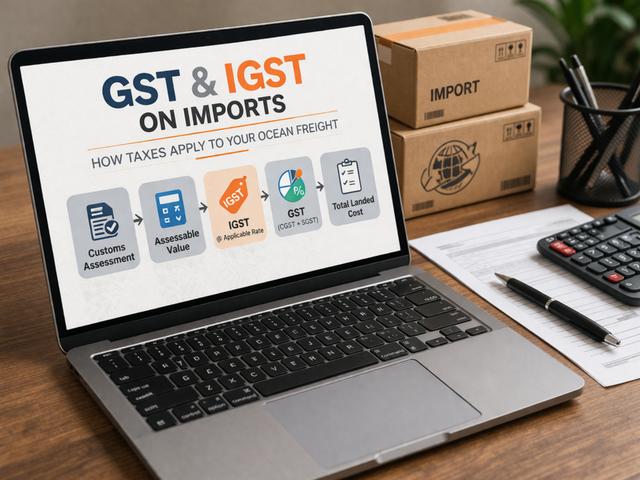
When Indian importers talk about “tax on freight,” they often mix up two different things: import IGST on the goods at customs and GST on separate logistics services. For most sea imports, the more important rule is this one: the freight element is already pulled into the customs valuation of the imported goods, and the IGST on imports is then collected at the customs stage under the Customs Tariff Act read with the IGST Act. That means ocean freight usually affects your tax bill even if no one sends you a separate “tax on freight” invoice.
There is also one major change importers should not miss. Effective 1 October 2023, the government removed the specific foreign-to-foreign ocean-freight wording from the service-rate notification and also omitted the old reverse-charge entry that had targeted importer-side tax on certain ocean-freight arrangements. In practice, that means importers should not budget a separate CIF ocean-freight RCM levy on top of the import IGST already collected through customs.
A common misunderstanding is that if the supplier ships on CIF, freight is “their cost” and therefore somehow outside your Indian tax base. That is not how customs valuation works. Section 14 of the Customs Act says imported goods are valued on transaction value, but it also says that imported value includes transportation, insurance, loading, unloading, and handling charges in the manner prescribed by the valuation rules. Rule 10 of the Customs Valuation Rules then makes that practical by requiring customs value to include transport to the place of importation, associated loading/unloading/handling, and insurance.
So whether you buy on CIF or FOB, freight still matters to import tax. Under CIF, it is usually already embedded in the supplier-side landed figure that customs will test. Under FOB, freight and insurance may be billed separately, but customs valuation still pulls those amounts into the import value for tax purposes.
The IGST Act specifically provides that goods imported into India are levied and collected in accordance with section 3 of the Customs Tariff Act on the value determined under that Act, at the point where customs duties are levied under section 12 of the Customs Act. So for imported goods, the tax point is not a regular domestic GST invoice cycle. It is the customs-clearance stage.
There is also a timing point many businesses overlook: under section 15 of the Customs Act, the applicable rate and valuation for home-consumption imports are generally the ones in force on the date the Bill of Entry is presented. Section 14 also links valuation to the exchange rate in force on the BoE date. So if freight or forex moves between planning and filing, your final import-tax number can move too.
Rule 10 of the Customs Valuation Rules says that the value of imported goods includes the cost of transport, loading/unloading/handling charges, and insurance up to the place of importation. That is the core reason ocean freight keeps showing up in import-tax calculations even when importers are not paying a separate tax line called “freight GST.”
This is also why freight planning and tax planning should not be separated. If the freight estimate is wrong, the customs value is wrong. And if the customs value is wrong, the import IGST calculation is wrong too.
The Customs Tariff Act framework says an imported article is liable to integrated tax under section 3(7), and the value for that IGST under section 3(8) is built as an aggregate of the imported article’s customs value and customs-duty components, excluding the import IGST and compensation cess themselves. That means the IGST base is usually bigger than the freight-inclusive invoice value alone.
In practical import math, this means freight first enters the assessable value, and then the import IGST is computed on a base that generally sits above that assessable value because customs-duty elements are layered in before IGST is calculated.
The 26 September 2023 notifications matter here. Notification 11/2023-Integrated Tax (Rate) removed the specific wording in the service-rate notification that had explicitly covered foreign-to-foreign vessel transportation up to the customs station in India, and Notification 13/2023-Integrated Tax (Rate) omitted serial number 10 from the reverse-charge notification, both effective 1 October 2023.
For importers, the simplest commercial takeaway is this: for CIF-type ocean imports, the freight element still affects customs IGST through valuation, but the old importer-side separate RCM ocean-freight charge should not be budgeted as an additional layer after 1 October 2023.
The CGST Act defines input tax to include the integrated tax charged on import of goods. Section 16 then sets the basic entitlement and conditions for taking input tax credit, and Rule 36 says that a Bill of Entry or similar customs document is one of the prescribed documents for claiming that credit.
Operationally, this has become more visible on the GST portal. From October 2025 onward, the portal introduced an Import of Goods section in IMS where Bills of Entry are made available for taxpayer action, and GSTR-2B now carries dedicated import-related sheets such as IMPG and amendment sections. That is useful because import IGST is not just a tax-payment issue; it is also a reconciliation issue.
Under CIF, your supplier’s commercial price usually includes freight and insurance, but Indian customs still taxes the imported goods on a value that includes those elements, and import IGST is then applied under the customs framework. Since the 2023 notification changes, you should not normally stack a separate importer-side CIF ocean-freight RCM on top of that.
Under FOB, freight and insurance are often separately contracted, but customs valuation still requires those costs to be included up to the place of importation. So even if the freight vendor and the goods supplier are not the same counterparty, the freight component still flows into import-tax math at customs.
Before the next ocean shipment is locked, check these points:
Confirm whether the deal is CIF or FOB, but remember that freight and insurance still feed customs valuation either way.
Use the Bill of Entry date and current customs exchange-rate assumptions for tax planning, not stale spreadsheet assumptions.
Do not add a separate CIF ocean-freight RCM line in your budget for post-1 October 2023 imports.
Keep the Bill of Entry clean, because it is the core tax document for import IGST credit.
Reconcile import IGST through the GST portal’s Import of Goods / IMS / GSTR-2B workflow where relevant.
Thinking freight is tax-free just because it sits in a freight line, not the goods line
Customs valuation rules explicitly pull transport, insurance, and associated handling into import value.
Budgeting import IGST only on supplier invoice value
The import IGST base is not just the product price. It is built through the Customs Tariff Act framework on a broader aggregate.
Using pre-October-2023 ocean-freight RCM assumptions for current CIF imports
The relevant 2023 notifications changed that rule position with effect from 1 October 2023.
Treating import IGST as a permanent cost without checking ITC eligibility
The GST credit chain can capture import IGST for eligible registered persons, but only when section 16 conditions and documentary rules are met.
This is where digital visibility matters. Cogoport’s Duties & Taxes Calculator is positioned around current tariff schedules, HS-code logic, trade-agreement provisions, and exemption schemes to help estimate import-side duties and taxes more accurately before booking. That is useful because freight and tax planning are only as good as the assumptions feeding them.
Its Freight Rates & Schedules product adds the other half of the picture by letting importers compare rates across carriers and trade lanes faster. For a shipment where freight directly affects assessable value and import IGST, faster rate comparison can translate into better landed-cost planning, not just a cheaper quote.
And when customs duty plus import IGST starts to pressure working capital, Cogoport’s Pay Later product says approved users can defer logistics payments for up to 90 days. That does not change the tax law, but it can change how easily a business absorbs the cash-flow impact of freight and import taxes landing at the same time.
For sea imports into India, the most important tax truth is simple: ocean freight usually affects your import IGST even when it is not separately taxed as “freight GST.” That is because customs valuation pulls freight and insurance into import value, and the Customs Tariff / IGST framework then taxes the imported goods on a broader base.
The second truth is just as important: for current CIF imports, do not keep carrying forward the old assumption that there is an extra importer-side RCM levy on ocean freight. The 2023 notification changes matter, and the right way to plan now is to model freight into customs value, calculate import IGST correctly, and keep the Bill of Entry and ITC trail clean.
Customs Act, 1962 — used for customs valuation principles, exchange-rate linkage, rate-in-force timing on the Bill of Entry date, and the customs-duty foundation.
Customs Valuation (Determination of Value of Imported Goods) Rules, 2007 — used for inclusion of transport, loading/unloading/handling, and insurance in customs value.
Integrated Goods and Services Tax Act, 2017 — used for the rule that imported goods are levied and collected in accordance with section 3 of the Customs Tariff Act.
Customs Tariff Act amendment text / section 3 framework — used for the import-IGST structure and the aggregate-value concept for imported goods.
Gazette Notifications 11/2023-Integrated Tax (Rate) and 13/2023-Integrated Tax (Rate) — used for the 1 October 2023 changes affecting the old ocean-freight language and reverse-charge entry.
CGST Act, section 2(62) and section 16 — used for input-tax definition including import IGST and the general conditions for taking ITC.
CGST Rules, Rule 36 — used for the Bill of Entry as a prescribed document for import-IGST credit.
GST Portal advisory on Import of Goods in IMS (2025) — used for the Oct 2025 import-of-goods workflow in IMS and the related GSTR-2B import sections.
Cogoport Duties & Taxes Calculator — used for Cogoport’s tax-estimation workflow.
Cogoport Freight Rates & Schedules — used for multi-carrier freight comparison and planning.
Cogoport Pay Later — used for deferred logistics-payment positioning.
The future of freight is becoming more predictive, connected, and digital. This blog explains how AI improves decision-making, IoT expands r...

Growing import businesses often lose time and money through manual freight coordination. This blog uses published SME examples to show how d...

Learn how online freight marketplaces help importers get instant container-shipping quotes, compare options quickly, and improve booking dec...