
Trade Guide
The Future of Freight: AI, IoT & Blockchain in International Shipping
The future of freight is becoming more predictive, connected, and digital. This blog explains how AI improves decision-making, IoT expands r...
Learn how shipment consolidation helps reduce freight costs by combining multiple orders, improving container utilization, and lowering logistics expenses.
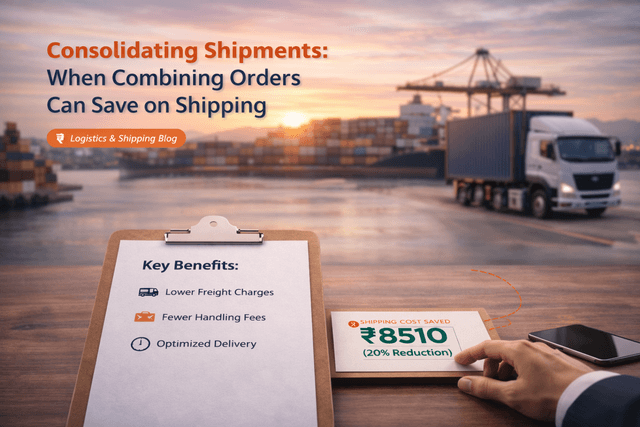
Shipping each purchase order separately often feels simple, but simplicity can be expensive. When smaller orders move one by one, importers can end up paying repeated minimum freight charges, repeated documentation costs, repeated handling charges, and sometimes repeated customs-processing effort. Consolidation is the opposite approach: combining multiple smaller shipments into one larger movement so transport space is used more efficiently. Maersk defines consolidation as combining less-than-full-load shipments at origin into one shipment, and DHL describes consolidated shipping as grouping smaller shipments into one larger consignment so businesses are not paying for half-empty space.
That is why consolidation is not just a warehouse trick. It is a freight-buying strategy. DHL says consolidation can lower rates by creating economies of scale and avoiding multiple minimum shipment fees, while UPS says consolidated freight can clear customs as one shipment, skip extra distribution steps, and support faster inventory turns and cash flow.
At a practical level, consolidation usually shows up in three common forms. The first is classic LCL consolidation, where a forwarder combines multiple smaller shipments into one container and deconsolidates them at destination. Cogoport’s LCL definition says a forwarder may consolidate multiple LCL shipments at a CFS before the container is gated in, and Maersk’s FAQ explains that deconsolidation is simply the reverse step at destination.
The second is buyer’s consolidation, where one buyer sources from multiple suppliers and combines those orders into one container movement. Cogoport says this model lets multiple suppliers pool cargo for a single international buyer, while Flexport says buyer’s consolidation uses digital planning to combine bookings with the same port pairing into one load plan.
The third is documentation consolidation, where a combined bill of lading can simplify paperwork for grouped shipments. Cogoport says a combined B/L can place multiple shipments under one set of documents, reducing banking and administrative friction when the routing, timing, and compliance conditions line up.
Many importers assume consolidation only matters when volumes are already close to a full container. Not necessarily. DHL says consolidation can be an effective way to pay less even for smaller shipments, because several smaller consignments can be turned into one larger shipment and priced more efficiently. Cogoport’s LCL guidance also notes that LCL is often the cheaper alternative for lower-volume, non-urgent cargo.
The real commercial question is not “Can I fill a container today?” The better question is “Am I paying avoidable freight and admin costs because I am shipping the same buying cycle in fragments?” UPS’s Trade Direct model is useful here because it shows how consolidation can replace multiple customs events and intermediate distribution handling with one coordinated movement.
This is the most obvious case. DHL says consolidated shipping works by grouping smaller shipments into one larger consignment, which improves space utilization and reduces duplicated costs. If several orders are already heading to the same market within a similar shipping window, separate movements often create repeated minimum charges that do not add much value.
Buyer’s consolidation is built for this. Cogoport says it allows multiple suppliers to pool shipments for one international buyer, with pickup schedules, documentation, and customs coordination managed centrally. Flexport adds that consolidation works especially well when bookings share the same port pairing and can be planned together through one load plan.
This is where importers often unlock savings that were previously reserved for larger shippers. Instead of moving several sub-scale shipments individually, the buyer aggregates them into one more efficient transport unit. Cogoport also notes that this model can open container-rate economics to smaller suppliers that would not reach FCL scale on their own.
Savings do not come only from line-haul freight. Flexport says buyer’s consolidation can, in many cases, avoid destination deconsolidation steps that LCL would otherwise require, which may reduce destination CFS fees. UPS similarly emphasizes clearing customs as one shipment rather than processing multiple entries separately.
Documentation can also be part of the savings. Cogoport says combined B/L structures can reduce banking and administrative overhead by grouping shipments under one documentation set when the cargo, routing, and compliance rules allow it.
This is often the biggest cost crossover. Flexport gives one illustrative example: three LCL shipments totaling 55 CBM on a Yantian–Los Angeles lane saved about 34% when consolidated instead of moving separately as LCL. Flexport is also careful to say the exact savings depend on the trade lane, shipment size, frequency, dwell time, and other variables, which is exactly the right way to think about it.
So the smartest importers do not ask whether every individual order is “big enough” for FCL. They ask whether the combined buying cycle is big enough.
DHL says consolidation can reduce duplicated paperwork and support faster clearance through grouped processing, and UPS says consolidated packages can clear customs as one shipment and then move directly into final delivery flows. Fewer handoffs and fewer repetitive administrative events can translate into lower operational cost, not just lower freight cost.
Consolidation usually works best when timing is predictable enough to coordinate without harming inventory availability. DHL frames consolidation as a strong fit for recurring international movements, and Cogoport notes that low-volume shipments can use LCL cost-effectively when cargo is not urgent.
Consolidation is not always the right answer. One obvious risk is waiting too long to combine cargo. Cogoport notes that businesses should avoid holding freight until a container is completely full if that makes products unavailable in the market or delays replenishment. In other words, a lower freight bill is not a saving if it creates stockouts or missed sales.
A second risk is cargo incompatibility or poor coordination. Cogoport’s combined B/L guidance says grouped shipments need compatible cargo, similar routing, coordinated schedules, and aligned regulatory requirements. If the shipments do not match operationally, forced consolidation can create delay and compliance trouble instead of savings.
A third risk is more handling complexity. DHL presents fewer touchpoints as one benefit of well-run consolidated shipping, but Cogoport also warns that consolidation and deconsolidation can increase handling points and therefore damage or delay risk if execution is weak. The lesson is not “avoid consolidation”; it is “avoid bad consolidation.”
And a fourth risk is dependency on missing or delayed cargo. Cogoport says buyer’s consolidation requires close control of pickup schedules and exception handling, while Flexport notes that shared LCL structures can create dependency on other parties’ customs or exam outcomes. If one supplier is not ready, the savings from combining orders can quickly be eaten by delay costs.
Use this before the next booking cycle:
Check whether multiple orders share the same destination country and similar shipping window. DHL and UPS both show the biggest benefits when cargo is grouped for one destination flow.
Add up the combined CBM, weight, and shipment frequency, not just each PO in isolation. Flexport says the savings inflection depends on lane, volume, shipment size, frequency, and dwell time.
Compare the cost of separate LCL shipments versus one buyer’s consolidation or FCL-style movement. Cogoport and Flexport both describe the advantages of pooling orders for one buyer.
Count the non-freight costs too: CFS, documentation, customs entries, and banking/admin work. UPS, DHL, and Cogoport all point to savings beyond the ocean or air line-haul alone.
Confirm that the cargo is compatible in routing, timing, and compliance before grouping it.
Do not consolidate if the delay needed to combine orders will create inventory gaps or missed delivery commitments.
Consolidating purely to chase a lower freight line item
If combining orders adds too much waiting time, the inventory damage can cancel the shipping savings. Cogoport’s guidance explicitly warns against holding cargo until a container is full if that hurts product availability.
Assuming every grouped shipment should stay in LCL form
Sometimes the smarter move is to stop paying by fragmented shipment and switch to buyer’s consolidation or a fuller container structure. Flexport’s example shows that, on some lanes, several LCL moves combined together can materially reduce total shipping cost.
Ignoring documentation and customs design
Cogoport’s combined B/L guidance and UPS’s one-clearance model both show that admin structure matters. If the shipment is physically consolidated but administratively messy, you may miss a big part of the savings.
Forgetting that more handling requires more control
Cogoport warns that additional touchpoints raise risk if tracking and execution are weak. Consolidation should come with better coordination, not less.
Cogoport’s value in this workflow is not only freight booking. Its buyer’s-consolidation guidance says the model works by coordinating supplier pickups, documentation, loading, and exception handling for one buyer, with real-time visibility and automated document workflows supporting the process. That is exactly the kind of coordination importers need when combining multiple orders into one movement.
Its Customs, CFS, and Handling product page is also relevant because it covers carrier liaisoning, pickup, port handling, customs, trucking, gate-out delivery, and container return, while also allowing invoices to be split or merged across the supply chain. That matters because consolidation savings are often lost during customs, CFS, and inland coordination rather than on the freight booking itself.
And Cogoport’s Door-to-Door product positions the company around detailed landed-cost breakup, coordinated freight, customs, trucking, handling, supplier collaboration, and end-to-end cargo and documentation visibility. For importers managing several suppliers at once, those capabilities map directly to the problems consolidation is supposed to solve.
Consolidating shipments saves money when it removes duplicated cost without creating bigger delays. The best use cases are straightforward: several small orders moving to the same market, multiple suppliers feeding one buyer, repeated LCL or admin costs that can be compressed, and total volume that is starting to justify a more efficient container plan. DHL, UPS, Flexport, Maersk, and Cogoport all point to the same core idea: better space utilization and fewer duplicated processes can produce real savings.
But consolidation only works when timing, cargo compatibility, documentation, and visibility are managed properly. That is why the winning question is not “Can I combine these orders?” It is “Can I combine them without creating a bigger cost somewhere else?” For Cogoport’s audience, that is where structured coordination and end-to-end execution make the difference.
Maersk, “What is the difference between consolidation and deconsolidation?” Used for the core definitions of consolidation and deconsolidation.
DHL Express Singapore, “What is consolidated shipping and why is it good for your business?” Used for how consolidated shipping works, grouped customs processing, fewer touchpoints, and faster clearance.
DHL India, “How to Reduce Your Export Shipping Charges.” Used for the point that consolidation can reduce costs by avoiding repeated minimum shipment fees.
DHL Global Forwarding India, “8 Proven Ways to Save Costs On Your Next Air Cargo Shipment.” Used for the explanation that consolidation can reduce air-freight cost by combining smaller shipments into larger ones.
UPS Supply Chain Solutions, “Consolidated Freight Shipping Solutions.” Used for one-clearance customs processing, skipping distribution-center steps, and faster inventory turns/cash flow.
Flexport, “How Flexport’s Buyer’s Consolidation Service Transforms Ocean Freight.” Used for buyer’s-consolidation planning logic, destination CFS avoidance in many cases, dependence risks in LCL, and the illustrative 55 CBM savings example.
Cogoport, “Buyers Consolidation.” Used for multiple-supplier-to-one-buyer consolidation, pickup/document coordination, visibility, and exception management.
Cogoport, “Combine B/L.” Used for grouped documentation benefits, banking/admin simplification, and the requirement for compatible cargo, routing, and schedules.
Cogoport, “Less than Container Load (LCL).” Used for LCL consolidation mechanics and the point that LCL can suit lower-volume, non-urgent cargo.
Cogoport, “Consolidation & Deconsolidation: Efficient Cargo Management.” Used for the risks of extra touchpoints, the inventory-availability tradeoff, and why waiting too long to fill freight can be counterproductive.
Cogoport, “Customs, CFS, and Handling.” Used for Cogoport’s coordination of carrier liaisoning, customs, trucking, port handling, gate-out, container return, and consolidated payments.
Cogoport, “Door-to-Door Shipments.” Used for detailed landed-cost breakup, supplier coordination, and end-to-end cargo/document visibility.
The future of freight is becoming more predictive, connected, and digital. This blog explains how AI improves decision-making, IoT expands r...

Growing import businesses often lose time and money through manual freight coordination. This blog uses published SME examples to show how d...

Learn how online freight marketplaces help importers get instant container-shipping quotes, compare options quickly, and improve booking dec...