Trade Guide
The Future of Freight: AI, IoT & Blockchain in International Shipping
The future of freight is becoming more predictive, connected, and digital. This blog explains how AI improves decision-making, IoT expands r...
Learn how pandemics, geopolitics, tariffs, and energy disruptions affect shipping costs, transit times, and import planning for India.
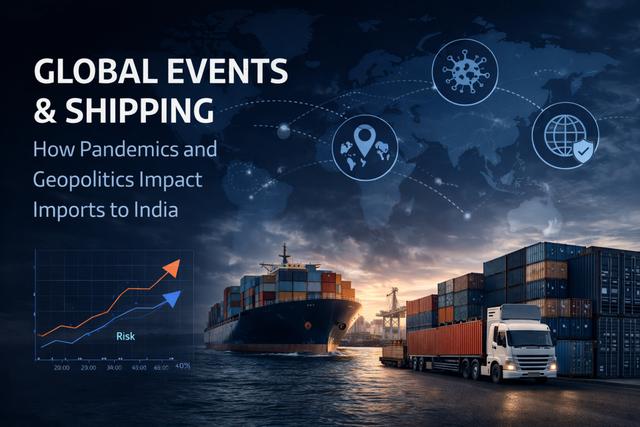
For Indian importers, global events do not stay “global” for very long. They show up in freight rates, transit times, cargo availability, energy costs, and working-capital pressure.
The pandemic made that painfully clear. The World Bank says disruptions caused by COVID-19 were important enough that it created the Global Supply Chain Stress Index in 2021 to track container-shipping stress more systematically. IMF research found that when freight rates double, inflation rises by about 0.7 percentage point, with effects lasting up to 18 months; the 2021 surge in shipping costs alone was estimated to add about 1.5 percentage points to inflation in 2022. UNCTAD’s COVID-era policy brief also said container freight rates reached historical highs because of carrier capacity management, severe container shortages, and pandemic-related delays in intermodal connections.
The same logic applies to geopolitics today. Route insecurity, sanctions, tariffs, chokepoint disruption, and energy volatility all change what Indian importers pay and how reliably cargo moves.
Many buyers assume geopolitics matters only if their own container is physically moving through the affected region. That is too narrow.
UNCTAD said during COVID that longer and thinner routes to developing regions were hit harder than the main east–west corridors when container shortages and delays spread. The World Bank later showed that an additional 1 million TEUs of supply-chain stress is associated with about a $2,300 per TEU increase in the Shanghai Containerized Freight Index. That means disruptions do not need to hit your exact lane directly to change pricing and reliability across the network.
The first channel is demand shock mixed with equipment imbalance.
UNCTAD said that at the start of COVID, the expectation was a trade downturn, but changing consumption patterns, e-commerce demand, stimulus-led buying, and inventory frontloading instead lifted containerized imports of manufactured goods. At the same time, capacity management, container shortages, and pandemic-linked intermodal delays pushed rates to historical highs. That combination is why import costs rose even when the original shock did not start inside shipping itself.
The second channel is rerouting.
UNCTAD’s 2025 Review of Maritime Transport says Suez Canal tonnage was still about 70% below 2023 levels by May 2025, showing how long route dislocation can last. Reuters also reported that Maersk’s gradual return to Suez could cut about a week off transit times, which shows the reverse as well: when routes normalize, transit and freight economics improve. Put simply, route security directly affects both time and cost.
The third channel is fuel and commodity exposure.
Reuters reported in March 2026 that the Strait of Hormuz normally carries around a fifth of global oil and seaborne LNG. The same month, Reuters reported that India’s LPG market had already been hit by shipping disruption in Hormuz, with 22 Indian-linked tankers stranded there and LPG sales in the first half of March down 17.3% year on year. Reuters also reported that Indian Oil booked some cargoes from Saudi Arabia’s Red Sea port of Yanbu as an alternative when Middle East exports were disrupted.
The fourth channel is policy.
The WTO’s 2025 outlook said world merchandise trade had grown 2.9% in 2024 but was expected to contract 0.2% in 2025 after accounting for newly announced tariffs and heightened policy uncertainty. Reuters then reported in March 2026 that the WTO expected goods-trade growth to slow to 1.9% in 2026 from 4.6% in 2025, and that it could weaken further to 1.4% if the Middle East conflict kept energy prices high and disrupted transport. That means import planning risk now comes from trade policy as well as physical shipping disruption.
The fifth channel is commercial knock-on effect.
Reuters reported on 19 March 2026 that Indian small and medium exporters were facing payment delays and cash-flow stress because war-risk premiums and emergency surcharges had driven freight rates sharply higher. India even launched a ₹4.97 billion support scheme for insurance cover on affected corridors. Whether the trigger is a pandemic, a war, or a tariff wave, the importer consequence is similar: more volatile landed cost, harder planning, and greater working-capital stress.
The most exposed businesses are usually the ones where freight instability becomes an inventory or revenue problem quickly.
That includes electronics and component importers, chemical and pharma input buyers, seasonal importers, project-linked cargo owners, and businesses that rely on air freight when ocean timing fails. In practice, the less buffer you carry and the tighter your delivery commitments are, the more global disruption turns into a domestic operating problem.
Use this before your next booking cycle:
Review whether any current shipment depends on vulnerable chokepoints.
Separate critical SKUs from routine replenishment.
Build alternate routing and mode-shift options before delays start.
Recheck insurance, surcharge, and fuel-cost assumptions.
Lock documentation early to avoid border-side delay on top of route delay.
Review safety stock on items exposed to global disruption.
Watch both trade-policy and freight-market updates, not just sailing schedules.
Recalculate working-capital exposure if freight costs rise quickly.
Keep air freight for shutdown-preventing cargo only.
Avoid promising customers dates based on ideal transit only.
These are the common importer mistakes in a shock-driven shipping market:
assuming the disruption matters only if cargo passes through the affected region
treating pandemics and geopolitics as “macro news” instead of freight variables
ignoring energy exposure in shipping and input costs
planning only around the ocean leg
switching too much cargo to air too late
underestimating the cash-flow effect of surcharges and delays
This kind of market rewards visibility and speed.
Cogoport’s official pages say the platform offers instant freight quotes, end-to-end logistics services, shipment tracking, a multi-shipment visibility dashboard, Cogo Assured, and Pay Later options. For importers dealing with macro shocks, that combination matters because rerouting, quote refreshes, and execution decisions need to happen quickly and with better shipment visibility.
Pandemics and geopolitics affect Indian imports not just by stopping cargo, but by changing the economics and reliability of getting cargo to India at all. COVID showed how demand shifts, equipment shortages, and congestion can explode rates and inflation. Current geopolitical tensions show how route insecurity, tariffs, and energy chokepoints can do the same through a different mechanism. The importers who plan for those shocks as live freight variables, not abstract global events, will usually protect cost, continuity, and customer service more effectively.
World Bank, “Global Supply Chain Stress Index.” Used for the definition and purpose of the GSCSI and its link to container-shipping disruption monitoring.
World Bank blog, “The COVID-19 shock prompted us to develop a new index of supply chain stress.” Used for the estimate that an extra 1 million TEUs of stress is associated with about a $2,300 per TEU increase in the Shanghai Containerized Freight Index.
IMF, “How Soaring Shipping Costs Raise Prices Around the World,” 28 Mar 2022. Used for the relationship between freight-rate doubling and inflation.
UNCTAD, “Container shipping in times of COVID-19: Why freight rates have surged and implications for policy makers,” Policy Brief No. 84. Used for pandemic-era freight-rate drivers, container shortages, and intermodal delays.
UNCTAD, “Review of Maritime Transport 2025.” Used for the continuing post-crisis stress on major maritime corridors, including the Suez Canal.
WTO, “Global Trade Outlook and Statistics 2025.” Used for 2024 trade growth, the 2025 downgrade, and the role of tariff and policy uncertainty.
Reuters, “World trade growth set to slow to 1.9% this year, Iran war may weigh more, says WTO,” 19 Mar 2026. Used for the 2026 slowdown scenario and the risk of further damage from energy and transport disruption.
Reuters, “India’s LPG consumption declines due to shortages in wake of Iran war,” 16 Mar 2026. Used for India’s LPG disruption, tanker delays, and Hormuz exposure.
Reuters, “Indian Oil Corp books some oil cargoes from Red Sea, source says,” 7 Mar 2026. Used for IOC’s alternative cargo sourcing via Yanbu.
Reuters, “Iran says Hormuz open to all but ‘enemy-linked’ ships,” 22 Mar 2026. Used for Hormuz’s role in global oil and LNG flows and the scale of the energy-shipping risk.
Reuters, “India offers insurance support as small exporters face cash-flow strain,” 19 Mar 2026. Used for war-risk premiums, emergency surcharges, and Indian trade-finance stress.
Reuters, “Maersk ramps up Suez Canal return that could dampen freight rates,” 15 Jan 2026. Used for the route-normalization effect on transit time and freight economics.
Cogoport, official platform, tracking, Cogo Assured, and Pay Later pages. Used for current product references in the Cogoport section.
The future of freight is becoming more predictive, connected, and digital. This blog explains how AI improves decision-making, IoT expands r...

Growing import businesses often lose time and money through manual freight coordination. This blog uses published SME examples to show how d...

Learn how online freight marketplaces help importers get instant container-shipping quotes, compare options quickly, and improve booking dec...