Trade Guide
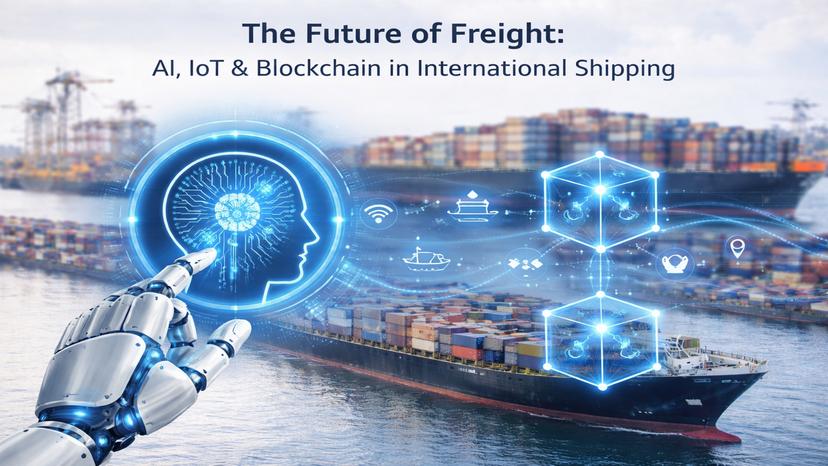
The Future of Freight: AI, IoT & Blockchain in International Shipping
The future of freight is becoming more predictive, connected, and digital. This blog explains how AI improves decision-making, IoT expands r...
A practical guide to India’s logistics infrastructure upgrades and their impact on shipping efficiency and import planning.
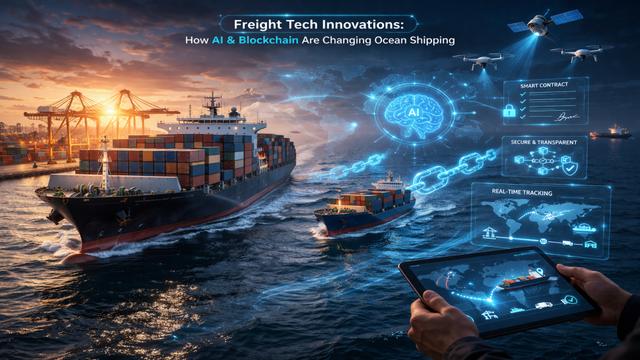
For importers, freight technology is no longer just a “nice-to-have” dashboard story. It is starting to change how shipping decisions are made, how documents move, and how quickly exceptions are detected.
UNCTAD says digitalization in maritime transport increasingly involves artificial intelligence, blockchain, the Internet of Things, and automation, and that these technologies help optimize processes, create new business opportunities, and transform supply chains. Its 2025 maritime overview adds that digital tools are already helping ports process containers in minutes rather than hours, while AI predicts congestion before it happens.
At the documentation level, DCSA says the bill of lading is still one of the most important trade documents in container shipping and that paper handling remains inefficient, expensive, and vulnerable to fraud. Its B/L standard is designed to enable straight-through digital processing, reduce manual intervention, improve customs and cargo handling speed, lower costs, reduce errors, and strengthen resilience. DCSA also says its member carriers are committed to 50% digital B/L issuance within five years and 100% by 2030.
That is why the real importer question is not just, “Which tool gives me tracking?” The better question is, “Which technology actually reduces delay, document friction, and decision latency in my shipment flow?”
Shipping still works with email chains, spreadsheets, couriered documents, and manual exception management. But that workflow is increasingly becoming the slowest part of the process.
DCSA says physical original bills of lading still have to be couriered so the importer can present them to collect goods, while the lack of standard formats and processes creates discrepancies, delays, and higher costs. ICC Academy notes that 4 billion documents move through the trade system on any given day and cites estimates that digitising bills of lading could save $6.5 billion in direct costs and enable roughly $40 billion in additional trade.
The first change is that AI is not only telling operators where cargo is. It is helping predict what goes wrong next.
UNCTAD’s 2025 review summary says AI systems are beginning to predict congestion before it happens. MSC’s shipping-technology article says AI can improve route planning, equipment reliability, workforce productivity, risk management, cybersecurity, inventory processes, cargo loading, and even fuel use and emissions. For importers, that means AI’s value is increasingly upstream of the delay, not just in explaining it after the fact.
The second change is in documentation.
DCSA says its B/L standard eliminates paper and manual intervention, improves customs-clearance efficiency, reduces physical-document costs, increases accuracy, lowers fraud risk, and improves resilience by reducing dependence on paper documents that can be lost or delayed in transit. It also cites a recent McKinsey estimate that full eBL adoption could unlock about $18 billion in ecosystem gains plus $30–40 billion in global trade growth.
The third change is trust and traceability.
ICC Academy says blockchain improves transparency, traceability, efficiency, security, and paperwork reduction in trade finance and logistics. It points to GSBN’s eBL solution as a real-world example, describing blockchain-based eBLs as a way to replace original paper bills with secure, immutable digital versions. WTO’s blockchain-and-DLT map likewise notes blockchain projects in shipping, logistics, supply chains, and trade digitisation.
The fourth change is scale.
DCSA’s 100% eBL initiative shows that the largest container carriers are no longer talking about digitisation as a pilot. They have made a public 2030 adoption commitment. ICC also reported in late 2024 that survey respondents saw faster processing, process-efficiency savings, higher data accuracy, and stronger security as core eBL benefits, with 94% saying eBLs are a cornerstone of broader digital trade transformation.
The fifth change is that ocean carriers and logistics groups are now deploying real budgets.
CMA CGM announced in April 2025 that it was adopting custom AI solutions from Mistral AI across shipping, logistics, and media activities. Reuters reported the partnership at €100 million, adding that it was meant to improve customer service and speed up handling of more than one million weekly emails. For importers, that matters because carrier AI investment increasingly affects response time, exception handling, and document workflows—not just internal analytics.
The first beneficiaries are usually the importers dealing with high shipment counts, document complexity, transshipment exposure, or repeated customs and handover friction.
That includes multi-container importers, businesses managing many bills of lading and supplier documents, cargo owners with tight delivery windows, and teams whose biggest pain is not the sailing itself but the time lost around documents, exceptions, and fragmented visibility. That inference follows directly from DCSA, ICC, MSC, and UNCTAD’s description of where friction still sits today.
Use this before your next digital-operations review:
Identify where your shipment workflow still depends on paper or email bottlenecks.
Ask whether your partners support interoperable eBL processes.
Separate visibility tools from predictive exception tools.
Review which document handoffs still delay cargo release.
Pilot digital workflows on one lane before scaling.
Check whether your current tech stack can ingest multi-carrier updates.
Treat blockchain as a trust and traceability layer, not a magic replacement for process discipline.
Check cybersecurity and access-control assumptions before digitising sensitive documents.
Align customs, bank, and logistics partners before changing document flow.
Measure success by time saved and errors avoided, not by software adoption alone.
These are the common freight-tech mistakes:
buying a dashboard without fixing document workflows
assuming AI automatically means better execution
adopting eBL tools without partner interoperability
expecting blockchain to solve operational gaps by itself
digitising processes without improving data quality or access control
Cogoport’s official pages position the platform around instant freight quotes, rates and schedules, tracking and visibility, and a broader digital trade workflow. Its tracking tools consolidate multiple data sources, show shipment milestones, and support a multi-shipment view, which is exactly the kind of operating layer importers need if they want technology to improve day-to-day execution instead of just adding another screen.
AI and blockchain are changing ocean shipping in a very specific way: AI is moving visibility closer to prediction, and blockchain-backed digital documents are moving trade closer to trusted paperless execution.
The most important change for importers is not the buzzword. It is the operational outcome: fewer manual handoffs, faster document movement, earlier risk signals, and less dependency on paper. The companies that adopt these tools where the friction really is—route planning, document processing, trade documentation, and exception management—will usually see more value than the ones who treat freight tech as only a tracking upgrade.
UNCTAD, “Digitalization in Maritime Transport: Ensuring Opportunities for Development.” Used for AI/blockchain relevance in maritime transport.
UNCTAD, Review of Maritime Transport 2025 overview. Used for digital tools, AI congestion prediction, and cyber-risk framing.
DCSA, Bill of Lading standard page. Used for paper-B/L problems, digital benefits, resilience, and trade-growth estimates.
DCSA, “100% eBL by 2030.” Used for the carrier commitment to 50% digital issuance within five years and 100% by 2030.
ICC Academy, “How the electronic bill of lading is transforming digital trade.” Used for 4 billion documents per day and eBL cost/trade benefits.
ICC Academy, “Blockchain in trade finance: Challenges and opportunities.” Used for blockchain transparency, smart contracts, paperwork reduction, and GSBN example.
WTO, “Blockchain and DLT in Trade: Where do we stand?” Used for the breadth of blockchain shipping/logistics projects.
ITC, “Electronic bills of lading can revolutionize international trade.” Used for eBL efficiency, security, sustainability, and cost-reduction framing.
ITC, “Expediting Trade Through Electronic Bills of Lading.” Used for the broader global eBL transition context.
MSC, “How AI can Help International Shipping Sail into the Future.” Used for route planning, equipment reliability, cargo loading, risk, and sustainability use cases.
CMA CGM, official Mistral AI partnership announcement. Used for CMA CGM’s AI deployment in shipping and logistics.
Reuters, “Shipping giant CMA CGM and French AI startup target customer service in tie-up,” 6 Apr 2025. Used for the €100 million investment and weekly-email workflow context.
World Economic Forum, “The TradeTech Paradox: Connectivity Amid Fragmentation” (2026). Used for the framing that technology and data are becoming connective tissue in trade.
ICC, survey on electronic bills of lading adoption (12 Dec 2024). Used for reported benefits such as faster processing, savings, accuracy, and security.
Cogoport, official platform, tracking, and OS pages. Used for current Cogoport product references.
The future of freight is becoming more predictive, connected, and digital. This blog explains how AI improves decision-making, IoT expands r...

Growing import businesses often lose time and money through manual freight coordination. This blog uses published SME examples to show how d...

Learn how online freight marketplaces help importers get instant container-shipping quotes, compare options quickly, and improve booking dec...