
Trade Guide
The Future of Freight: AI, IoT & Blockchain in International Shipping
The future of freight is becoming more predictive, connected, and digital. This blog explains how AI improves decision-making, IoT expands r...
Importers now have more choice than ever between traditional freight forwarders and digital logistics platforms. This blog explains how the two models differ in pricing, visibility, documentation, support, and scalability. It helps importers understand which forwarding setup fits their shipment complexity and operational needs.
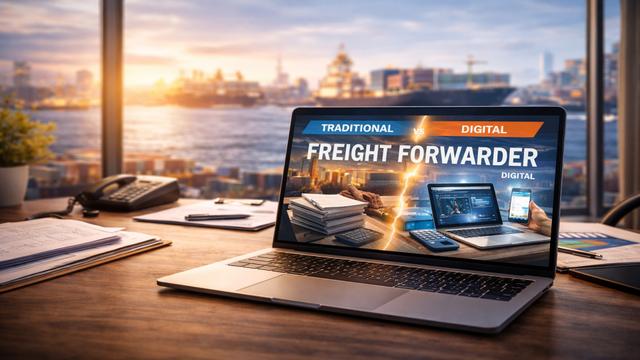
For importers, the freight-forwarder decision is no longer just about who can book space. It is increasingly about which operating model gives better control over rates, documents, visibility, and exceptions. FIATA says the freight forwarder’s core job is to move goods from origin to destination so they arrive at the right place, at the right time, in good condition, and at the most economical cost. What has changed is the workflow around that role: digital platforms now layer instant quotes, online booking, live tracking, analytics, digital documents, and API-driven coordination on top of traditional forwarding services. Cogoport’s platform, DHL’s myDHLi, and Maersk’s digital-services stack all reflect that shift toward online quote-book-track-manage workflows.
FIATA’s digital strategy says forwarders are moving toward authenticated data exchange, digital documents, interoperability, and digital identity. DCSA’s 2026 roadmap pushes the same direction at the container-shipping layer, with APIs designed to support the end-to-end shipment journey from the initial declaration through final invoicing and import release, with fewer manual handoffs. That is why the real choice today is not “old versus new.” It is whether an importer wants a primarily relationship-driven forwarding model, a platform-led model, or a hybrid of both.
A long-standing freight relationship can still work very well. But if the workflow around that relationship is mostly email, spreadsheets, and manual follow-up, it may become slower and less transparent as shipment count, supplier count, or corridor complexity rises. DHL says digital portals now combine quote, booking, tracking, documents, reports, and analytics in one place, while Maersk describes its digital solutions as tools to instantly book, manage, and track shipments with greater end-to-end visibility. The business impact is straightforward: when importers need faster decisions or cleaner coordination, workflow design matters almost as much as rate.
At the same time, digital does not automatically mean better in every situation. FIATA still frames the forwarder as the coordinating party responsible for getting cargo to destination correctly and economically, which is why hands-on advisory support remains valuable for irregular cargo, documentation-heavy moves, dispute handling, and exception-led shipments. In practice, the strongest model for many importers is not purely manual or purely self-serve. It is the one that combines usable digital tools with dependable operational support.
Digital forwarders usually win on rate discovery and booking speed. Cogoport’s rates page says users can get instant multi-carrier rates and schedules and compare options quickly, while myDHLi positions itself around Quote + Book + Track + Documents + Analytics in one portal. That kind of workflow is especially useful when an importer wants to compare multiple sailing options before cargo is ready. A traditional forwarder can still provide competitive pricing, but the turnaround may depend more on human response cycles, inbox load, and branch-level coordination.
Digital models usually have a structural advantage in visibility. Cogoport’s tracking tools provide a global shipment view, bulk upload, shareable live-tracking links, and milestone-based visibility across carriers. DHL says data integration and visibility help companies reduce delays, optimize routes, forecast better, and proactively resolve issues. Maersk’s Visibility Studio and Logistics Hub are built around predictive insights and end-to-end shipment control. That means digital-forwarder models are often better suited to importers who want control towers rather than only status updates.
Digital-forwarder models also tend to be stronger where documentation volume is high. FIATA’s digital strategy emphasizes secured data exchange and digital standard trade documents, while DCSA’s standards work is designed to improve interoperability and reduce complexity across container shipping. Cogoport’s import-documentation content explicitly frames digital workflows as a way to validate entries, auto-fill forms, predict document gaps, and reduce back-and-forth with customs and freight partners. Traditional forwarders can manage the same process, but they often do so through more fragmented manual exchanges.
Traditional forwarders often still have an edge in relationship-heavy exception management. FIATA’s definition of freight forwarding is broad enough to include carriage, consolidation, handling, advisory, and coordination functions, which is why importers moving unusual cargo or operating in exception-heavy corridors often value personal escalation channels. Digital models are improving rapidly, but even DCSA’s roadmap and FIATA’s digital strategy both imply that interoperability and digital handoffs are still being built out across the wider ecosystem. In other words, digital tools can reduce friction, but human escalation still matters when the shipment is no longer standard.
Digital-forwarder models often become more attractive as shipment volume grows. A platform that combines rates, schedules, tracking, door-to-door execution, insurance, and financial tools can reduce the cost of coordination per shipment. Cogoport’s home page, Door-to-Door page, Cargo Insurance page, and Pay Later page all point in that direction: plan, book, track, protect, and finance in one workflow. That is hard to replicate in a purely manual model unless the importer has a very strong internal logistics team.
Importers with irregular cargo, highly customized requirements, or relationship-led buying may still prefer a traditional forwarder model, especially if they rely on branch-level intervention and bespoke coordination. Importers with repeat lanes, multiple shipments, tighter reporting requirements, or a need for live visibility usually gain more from a digital-forwarder model. A hybrid approach often makes the most sense for businesses that want online speed and transparency without giving up hands-on operational support for exceptions. That is an inference from how FIATA describes the forwarding role and how modern logistics portals are being built by Cogoport, DHL, and Maersk.
Use this before your next freight-partner review:
Check how quickly the forwarder can return live rates and schedules.
Ask whether booking, tracking, documents, and invoices sit in one system.
Review how shipment exceptions are escalated.
Check whether customs, handling, and inland movement are integrated.
Ask what visibility you get after booking, not only before.
Review financial flexibility if freight volatility affects cash flow.
Confirm whether the platform or team supports your actual corridors and cargo types.
Test one live shipment workflow before making a broader switch.
These are the common mistakes importers make in this choice:
assuming digital always means less support
assuming traditional always means better service
comparing only freight rate and not workflow quality
ignoring visibility until shipment volume grows
choosing a platform without checking exception handling
choosing a relationship without checking digital maturity
Cogoport is useful in this comparison because it combines many of the advantages importers normally associate with digital forwarders without limiting the workflow to quote discovery alone. Its platform offers instant multi-carrier freight quotes and schedules, online booking for FCL, LCL, and air, end-to-end services including customs and door-to-door execution, real-time tracking with a global shipment view, cargo insurance, and deferred-payment tools through Pay Later. Cogo Assured adds assured fulfillment, fixed pricing, and priority treatment, which is especially helpful when importers want more predictability after booking. CogoAI adds another layer by helping users compare rates, check schedules, track cargo, and get quick logistics answers from one interface. For importers, that means Cogoport can function as a discovery tool, an execution layer, and a coordination layer at the same time. That broader operating model is what makes a digital-forwarder workflow practical for day-to-day importing rather than just convenient in theory.
Traditional and digital freight forwarders solve the same core problem, but they do it through different operating models. Traditional forwarders often offer stronger handholding in unusual situations, while digital forwarders usually offer faster discovery, cleaner visibility, and more scalable workflows. For most importers, the best answer is not ideological. It is practical: choose the model that best fits your shipment complexity, visibility needs, internal bandwidth, and tolerance for manual coordination.
FIATA, About Freight Forwarding. Used for the core role of the freight forwarder in international trade.
FIATA, Digital Strategy. Used for authenticated data exchange, digital documents, and interoperability priorities.
DCSA, Standards Roadmap 2026. Used for end-to-end API handoffs and improved ecosystem visibility.
DCSA, Digital shipping standards. Used for interoperability and efficiency framing.
Cogoport, Book & Manage Shipments & Cargo Online. Used for instant freight quotes, end-to-end logistics, and customs-linked service references.
Cogoport, Freight Rates & Schedules. Used for instant multi-carrier rates and schedules.
Cogoport, Tracking and Visibility. Used for global shipment view, bulk upload, and live tracking references.
Cogoport, Door to Door Shipments. Used for integrated freight, customs, trucking, and handling workflow.
Cogoport, Cogo Assured. Used for assured fulfillment, fixed pricing, and priority treatment.
Cogoport, Pay Later. Used for deferred-payment and financial dashboard references.
Cogoport, CogoAI. Used for AI-assisted rate comparison, shipment tracking, and logistics-query support.
DHL, Explore myDHLi. Used for Quote + Book + Track + Documents + Analytics portal features.
DHL, Data and Visibility in Freight Forwarding. Used for the operational benefits of integrated visibility.
Maersk, Digital Logistics Services. Used for online booking, management, and tracking references.
Maersk, Logistics Hub. Used for centralised end-to-end supply-chain visibility.
Maersk, Visibility Studio. Used for predictive visibility and actionable supply-chain data.
The future of freight is becoming more predictive, connected, and digital. This blog explains how AI improves decision-making, IoT expands r...

Growing import businesses often lose time and money through manual freight coordination. This blog uses published SME examples to show how d...

Learn how online freight marketplaces help importers get instant container-shipping quotes, compare options quickly, and improve booking dec...