
Trade Guide
The Future of Freight: AI, IoT & Blockchain in International Shipping
The future of freight is becoming more predictive, connected, and digital. This blog explains how AI improves decision-making, IoT expands r...
Learn the key documents required for FCL shipments to India, including Bill of Entry, invoice, packing list, bill of lading, IEC, and regulatory papers.
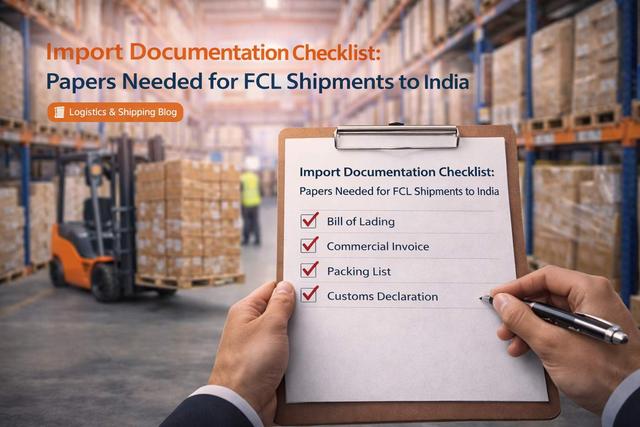
For many importers, FCL shipping feels simpler than LCL because one buyer controls one full container. But documentation does not get simpler just because the container is dedicated. India-bound FCL cargo still depends on a clean customs filing, the right supporting documents on ICEGATE/eSANCHIT, and the right release paperwork with the shipping line or its agent. When those papers do not line up, the result is usually not a minor inconvenience. It is delay, storage risk, and sometimes detention or demurrage. ICEGATE’s own document guidance shows that the Bill of Entry sits alongside supporting documents such as the bill of lading, commercial invoice, and packing list, with additional documents depending on the commodity and Participating Government Agency requirements.
For India imports, the practical rule is simple: think in two layers. First, there is the customs layer-Bill of Entry plus supporting documents. Second, there is the cargo-release layer-the bill of lading/sea waybill release status, delivery order, local charges, and pickup planning. That second layer matters especially in FCL because the full container cannot move out efficiently unless customs clearance and line release are ready at roughly the same time. Cogoport’s India FCL guidance specifically recommends preparing documents before arrival, coordinating advance Bill of Entry filing, and arranging local charges and delivery orders with the shipping line’s agent.
A common importer mistake is assuming that once the supplier has loaded the container and the carrier has issued the bill of lading, the paperwork is basically done. It is not. ICEGATE’s FAQ and eSANCHIT guidance show that the Indian-side filing stack still has to be complete, and that the upload set can expand depending on the goods, the notification being claimed, and the agency involved in clearance. That means the “documents needed” list is partly universal and partly commodity-specific.
There is also an India-specific identity and policy layer. DGFT’s January 2026 IEC guidance says all who intend to import or export are required to have an IEC, subject to exempt categories. DGFT also states separately that items marked as restricted in the ITC(HS) import policy require a licence prior to importation. So the document checklist is not just about shipment papers; it also includes the importer’s policy readiness.
For India customs, the core filing document is the Bill of Entry. ICEGATE’s web-form guidance and BE message documentation identify Bill of Entry as the import declaration submitted by the importer or customs broker to Customs, and the available BE types include home consumption and warehousing. In practice, this is the document on which classification, value, duty, exemptions, and agency declarations are made. If the Bill of Entry is wrong, the rest of the file usually stops moving smoothly.
A useful extra point for GST-registered importers: keep the assessed Bill of Entry carefully even after clearance. Under Rule 36 of the CGST Rules, a bill of entry or similar customs document is one of the prescribed documents for claiming input tax credit of IGST on imports. So for many businesses, the Bill of Entry is not just a port-clearance paper. It is also a tax-credit paper.
The commercial invoice is one of the standard supporting documents expected in the import file. ICEGATE’s FAQ and eSANCHIT process guide both list the commercial invoice among the core documents uploaded or referenced for import filing. Cogoport’s India ocean-freight documentation guide also notes that the invoice should carry the commercial details customs actually relies on-description, value, and sale terms-so mismatches here create downstream problems fast.
The packing list is another standard document in the ICEGATE/eSANCHIT stack. ICEGATE’s FAQ explicitly accepts a packing list or, in many cases, a commercial-invoice-cum-packing-list format. For FCL cargo, this document becomes even more important because one container can still carry multiple SKUs, pallets, cartons, or package types, and customs examination is much smoother when weights, dimensions, marks, and package counts are cleanly stated.
The bill of lading is the core transport document for an ocean shipment, and ICEGATE’s own guidance lists bill of lading/airway bill among the standard supporting documents. Cogoport’s India import documentation guide describes the Bill of Lading or Sea Waybill as part of the basic sea-freight document set for imports to India. For FCL cargo, this document also carries operational details that matter in practice, including the shipment identity and, ideally, the correct container and seal linkage. Cogoport’s China-to-India FCL guide specifically recommends recording the seal number on the bill of lading.
DGFT’s current IEC guidance says that persons who intend to import or export are required to have an IEC, subject to exemptions. Cogoport’s FCL India guide likewise flags IEC as mandatory for commercial imports and advises keeping IEC details ready for customs filing. This is one of the most basic checklist items, but it is still often overlooked by first-time importers who focus only on supplier papers and freight booking.
A certificate of origin is not a universal requirement in the same way as invoice, packing list, and bill of lading. But if you want a preferential rate of duty under a trade agreement, India’s CAROTAR 2020 rules make it very important. Rule 3 says that when the importer claims a preferential rate, the importer or agent must make the declaration in the Bill of Entry, produce the certificate of origin for each item claimed, and enter specified certificate details in the Bill of Entry. So the right way to think about COO is: conditional, but critical when claiming FTA benefit.
Not every import needs a licence. But DGFT’s import-management guidance states clearly that items classified as restricted under the ITC(HS) import policy require a licence before importation. That is why one of the smartest checklist steps is to settle classification and policy status before the container sails. A licence problem discovered after arrival is far more expensive than one solved before booking.
ICEGATE’s FAQ and eSANCHIT guidance both say that beyond the core document set, additional documents depend on the imported commodity, the notification claimed, and the Participating Government Agency requirement. In practice, that is where food, electronics, telecom, chemicals, medical, and similar regulated goods start to diverge from a “basic” documentation set.
Two official examples make this concrete. FSSAI’s imports page says food imports are processed through the Food Import Clearance System integrated with ICEGATE under SWIFT, and BIS states that certain products covered by Quality Control Orders can be imported only with the Standard Mark under a valid BIS licence or certificate of conformity. So for food, electronics, and other regulated cargo, the checklist is not complete until the relevant agency clearance is accounted for.
An insurance certificate is commonly part of the ocean-freight document set, but it is not equally relevant on every shipment. Cogoport’s India documentation guide includes insurance certificate in the standard sea-freight set, while its China-to-India FCL guide places it in the core documents where needed. In practice, this matters most under CIF-style deals, documentary-credit transactions, or when the buyer wants proof of transit cover.
A delivery order is not the same thing as the Bill of Entry, but for FCL imports it is often the document that turns customs-cleared cargo into physically releasable cargo. Cogoport’s India FCL guide tells importers to arrange local charges and delivery orders with the shipping line’s agent before pickup, and its DPD explainer shows how advance bill-of-lading submission and e-DO issuance fit into faster port release. That makes delivery-order planning part of the real-world FCL document checklist, even if it sits on the operational side rather than the customs side.
FCL does not change the legal identity of the main customs papers, but it does change how operationally important some of them become. In FCL, one mismatch in consignee name, container/seal data, release mode, or delivery-order handling can hold up an entire full container, not just a few cartons in a shared consignment. That is why Cogoport’s FCL guidance emphasizes preparing documents in advance, filing the Bill of Entry early, and lining up release and local transport before arrival.
The simplest FCL habit to build is document consistency. Your invoice, packing list, bill of lading, HS classification, and any licence or certificate details should describe the same goods in the same commercial logic. ICEGATE’s BE message format also shows that supporting documents are formally referenced in customs filing with document type, reference number, issue date, and, where relevant, expiry and beneficiary details. That is another reason sloppy documentation creates customs queries so quickly.
Use this before your next India-bound FCL shipment:
Confirm that the Bill of Entry filing plan is ready and that your customs broker has the document set before arrival.
Check that your commercial invoice, packing list, and bill of lading/sea waybill are consistent in description, values, package count, and shipment identifiers.
Keep your IEC active and ready, and verify early whether the item is restricted under ITC(HS).
If you are claiming an FTA benefit, make sure the certificate of origin is valid and the relevant declaration can be made in the Bill of Entry.
If the cargo is regulated, settle the PGA requirement early-food, BIS-covered items, and similar goods should not be treated like generic cargo.
Plan the delivery order and pickup side before berthing, not after assessment.
Assuming the supplier’s bill of lading is “the whole file.”
Indian import clearance still depends on the Bill of Entry and the ICEGATE/eSANCHIT supporting set, plus any commodity-specific documents.
Treating certificate of origin as mandatory on every shipment.
It becomes critical when you are claiming a preferential duty rate; otherwise, it is not the same kind of universal document as invoice, packing list, or bill of lading.
Forgetting that restricted goods need policy clearance before import.
DGFT’s import-management page is explicit that restricted items require a licence prior to importation.
Ignoring the operational release side of FCL.
A customs-cleared container can still sit if local charges, delivery order, or pickup planning are not ready.
This is exactly where a digital workflow helps. Cogoport’s India documentation guides break down the typical sea-freight import file into the practical papers importers actually use: Bill of Entry, invoice, packing list, bill of lading or sea waybill, certificate of origin where needed, insurance certificate, import licence where applicable, and technical or regulatory documents for controlled goods. Its China-to-India FCL guide adds the operational side-advance filing, delivery-order coordination, duty planning, and local transport readiness.
For FCL shipments especially, that combination matters. It is not enough to know the names of the documents. You need the customs file, the release file, and the inland-delivery plan to be ready together. That is where a platform-led workflow can prevent documentation mistakes from turning into port-cost mistakes.
For most commercial FCL imports into India, the document stack starts with the Bill of Entry, commercial invoice, packing list, bill of lading/sea waybill, and IEC. After that, the checklist branches depending on what you are importing and what benefit or policy route you are using: certificate of origin for preferential duty claims, DGFT licence for restricted goods, and PGA documents such as FSSAI or BIS paperwork where the commodity requires it. Then, on the operational side, FCL release usually still needs the shipping line’s release flow and delivery order to be in place.
The best way to use this checklist is not after the vessel arrives. It is before the container sails. That is when documentation is still cheap to fix. After arrival, it usually becomes expensive.
ICEGATE, “FAQ’s on ICEGATE.” Used for the core supporting-document set, including commercial invoice, packing list or invoice-cum-packing-list, and Bill of Entry.
ICEGATE, “eSanchit Frequently Asked Questions” and “e-Sanchit application process guide for PGA Users.” Used for the standard upload set-Bill of Lading/Airway Bill, Commercial Invoice, Packing List, Bill of Entry-and the point that extra documents depend on commodity, notification, and PGA requirement.
ICEGATE, “Web Forms” and BE message-format guidance. Used for Bill of Entry filing through ICEGATE, the role of the importer/CHA, BE types, and the structured reference to supporting documents in customs filing.
DGFT, “Detailed Guidelines for Issuance / Updation of Importer Exporter Code (IEC)” (19 Jan 2026). Used for the point that persons intending to import/export are required to have an IEC, subject to exemptions.
DGFT, “Services under Import Management System - Licence for Restricted Imports” and Restricted Imports FAQs. Used for the rule that restricted items require a licence prior to importation.
CBIC, “Customs (Administration of Rules of Origin under Trade Agreements) Rules, 2020.” Used for certificate-of-origin requirements when claiming preferential duty under a trade agreement.
FSSAI, “Imports” / FICS guidance. Used for the example that food imports go through the Food Import Clearance System integrated with ICEGATE under SWIFT.
BIS, “Products under Compulsory Certification” and FMCS FAQs. Used for the example that certain QCO-covered imported products require BIS compliance before import.
CGST Rules, Rule 36. Used for the point that a Bill of Entry is a prescribed document for claiming input tax credit of IGST on imports.
Cogoport, “Documents for Ocean Freight to India” and “Documents for Ocean Freight to India: Complete Guide.” Used for the practical India import document list, including Bill of Entry, invoice, packing list, bill of lading/sea waybill, insurance, licence, and technical/regulatory documents.
Cogoport, “How to Import from China to India: Step-by-Step FCL Guide for SMEs.” Used for FCL-specific operational guidance on seal details, advance Bill of Entry filing, delivery-order coordination, and local pickup planning.
Cogoport, “Impact of India’s Direct Port Delivery?” Used for the practical release-side sequence involving BL submission, advance e-DO, and pickup coordination for FCL cargo.
The future of freight is becoming more predictive, connected, and digital. This blog explains how AI improves decision-making, IoT expands r...

Growing import businesses often lose time and money through manual freight coordination. This blog uses published SME examples to show how d...

Learn how online freight marketplaces help importers get instant container-shipping quotes, compare options quickly, and improve booking dec...